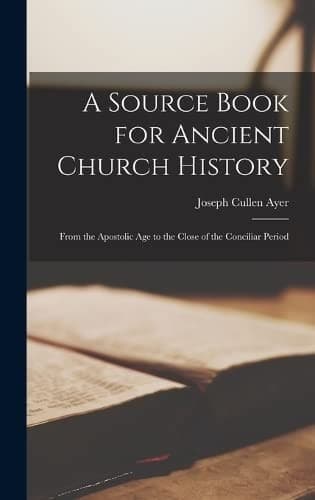
A Source Book for Ancient Church HistoryAyer, Joseph Cullen
History
A Source Book for Ancient Church History
Ayer, Joseph Cullen
Church history -- Primitive and early church, ca. 30-600 -- Sources
and thus was formed a custom for their posterity, according to their own
simplicity and their peculiar method. Yet all these lived more or less in
peace, and we also live in peace with one another; and the disagreement in
regard to the fast confirms the agreement in the faith.… Among these were
the elders [_i.e._, bishops of earlier date] before Soter, who presided
over the church which thou [Victor] now rulest. We mean Anicetus, and
Pius, and Hyginus, and Telesphorus, and Sixtus. They neither observed it
themselves nor did they permit others after them to do so. And yet, though
they did not observe it, they were none the less at peace with those who
came to them from the parishes in which it was observed, although this
observance was more opposed to those who did not observe it. But none were
ever cast out on account of this form, but the elders before thee, who did
not observe it, sent the eucharist to those of the other parishes
observing it. And when the blessed Polycarp was at Rome in the time of
Anicetus, and they disagreed a little about certain other things, they
immediately made peace with one another, not caring to quarrel over this
point. For neither could Anicetus persuade Polycarp not to observe what he
had always observed with John, the disciple of the Lord, and the other
Apostles with whom he had associated; neither could Polycarp persuade
Anicetus to observe it, as he said that he ought to follow the customs of
the elders who had preceded him. But though matters were thus, they
nevertheless communed together and Anicetus granted the eucharist in the
church to Polycarp, manifestly as a mark of respect.(58) And they parted
from each other in peace, maintaining the peace of the whole Church, both
of those who observed and those who did not.” Thus Irenæus, who was truly
well named, became a peace-maker in this matter, exhorting and negotiating
in this way for the peace of the churches. And he conferred by letter
about this disputed question, not only with Victor, but also with most of
the other rulers of the churches.
§ 39. The Religion of the West: Its Moral and Juristic Character
Public-domain text, read in full here on John Shaqi.
Reviews
Reviews
No reviews yet
Be the first to share your thoughts on this work.
Elsewhere in the archive
Join the Discussion
Join the discussion
Sign in to leave a comment or review.
Sign InorCreate an account