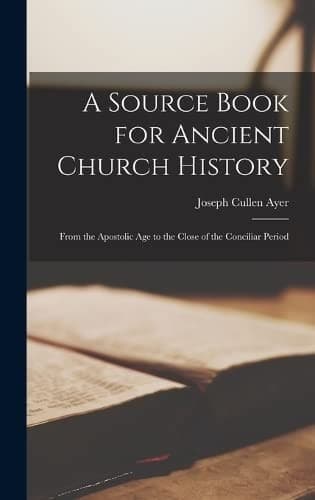
A Source Book for Ancient Church HistoryAyer, Joseph Cullen
History
A Source Book for Ancient Church History
Ayer, Joseph Cullen
Church history -- Primitive and early church, ca. 30-600 -- Sources
They have treated the divine Scriptures recklessly and without fear; they
have set aside the rule of ancient faith; and Christ they have not known,
not endeavoring to learn what the divine Scriptures declare, but striving
laboriously after any form of syllogism which may be found to suit their
impiety. And if any one brings before them a passage of divine Scripture,
they see whether a conjunctive or a disjunctive form of syllogism can be
made from it. And as being of the earth and speaking of the earth and as
ignorant of Him that cometh from above, they devote themselves to geometry
and forsake the holy writings of God. Euclid is at least laboriously
measured by some of them; Aristotle and Theophrastus admired; and Galen,
perhaps, by some is even worshipped. But that those who use the arts of
unbelievers for their heretical opinion and adulterate the simple faith of
the divine Scriptures by the craft of the godless are not near the faith,
what need is there to say? Therefore, they have laid their hands boldly
upon the divine Scriptures, alleging that they have corrected them. That I
am not speaking falsely of them in this matter, whoever wishes can learn.
For if any one will collect their respective copies and compare them with
one another, he will find that they differ greatly.
(B) Modalistic Monarchianism
Additional source material: Hippolytus, _Adversus Noetum,
Refutatio_, IX, 7 _ff._, X, 27; Tertullian, _Adversus Praxean_;
Basil, _Ep._ 207, 210. (PNF, ser. II, vol. VIII.)
(_a_) Hippolytus, _Refut._, X, 27. (MSG, 16:3440.)
The following passages from the great work of Hippolytus give the
earlier form of Modalistic Monarchianism. They are also of
importance as being a part of the foundation for the statement of
Harnack and others, that this heresy was the official Roman
doctrine for some years. See also IX, 12, of which the text may be
found in Kirch, nn. 201-206. The whole question as to the position
of Callistus, or Calixtus, as bishop of Rome and his relations to
the Church as a whole is difficult and full of obscurity, due to a
large extent to the fact that the principal source for his history
is the work of Hippolytus, who, as may easily be seen, was
bitterly opposed to him.
Public-domain text, read in full here on John Shaqi.
Reviews
Reviews
No reviews yet
Be the first to share your thoughts on this work.
Elsewhere in the archive
Join the Discussion
Join the discussion
Sign in to leave a comment or review.
Sign InorCreate an account