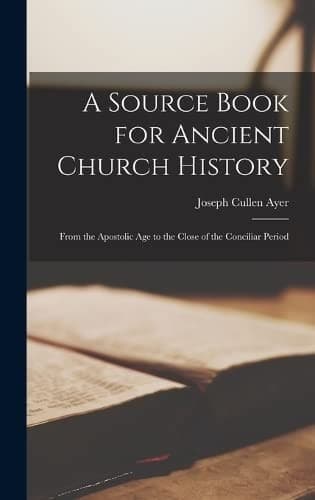
A Source Book for Ancient Church HistoryAyer, Joseph Cullen
History
A Source Book for Ancient Church History
Ayer, Joseph Cullen
Church history -- Primitive and early church, ca. 30-600 -- Sources
Ch. 15. But since, if the usefulness of the legislation and the sequence
and beauty of the history were universally evident, we should not believe
that any other thing could be understood in the Scriptures save what was
obvious, the Word of God has arranged that certain stumbling-blocks, and
offences, and impossibilities, should be introduced into the midst of the
law and the history, in order that we may not, through being drawn away in
all directions by the merely attractive nature of the language, either
altogether fall away from the true doctrines, as learning nothing worthy
of God, or, by not departing from the letter, come to the knowledge of
nothing more divine. And this, also, we must know: that, since the
principal aim is to announce the “spiritual” connection in those things
that are done and that ought to be done where the Word found that things
done according to the history could be adapted to these mystic senses, He
made use of them, concealing from the multitude the deeper meaning; but
where in the narrative of the development of super-sensual things there
did not follow the performance of those certain events which was already
indicated by the mystical meaning the Scripture interwove in the history
the account of some event that did not take place, sometimes what could
not have happened; sometimes what could, but did not happen.… And at other
times impossibilities are recorded for the sake of the more skilful and
inquisitive, in order that they may give themselves to the toil of
investigation of what is written, and thus attain to a becoming conviction
of the manner in which a meaning worthy of God must be sought out in such
subjects.
§ 44. Neo-Platonism
The last phase of Hellenic philosophy was religious. It aimed to combine
the principles of many schools of the earlier period and to present a
metaphysical system that would at once give a theory of being and also
furnish a philosophical basis for the new religious life. This final
philosophy of the antique world was Neo-Platonism. It was thoroughly
eclectic in its treatment of earlier systems, but under Plotinus attained
no small degree of consistency. The emphasis was laid especially upon the
religious problems, and in the system it may be fairly said that the
religious aspirations of heathenism found their highest and purest
expression. Because it was in close touch with current culture and in its
metaphysical principles was closely akin to the philosophy of the Church
teachers, we find Neo-Platonism sometimes a bitter rival of Christianity,
at other times a preparation for the Christian faith, as in the case of
Augustine and Victorinus.
Public-domain text, read in full here on John Shaqi.
Reviews
Reviews
No reviews yet
Be the first to share your thoughts on this work.
Elsewhere in the archive
Join the Discussion
Join the discussion
Sign in to leave a comment or review.
Sign InorCreate an account