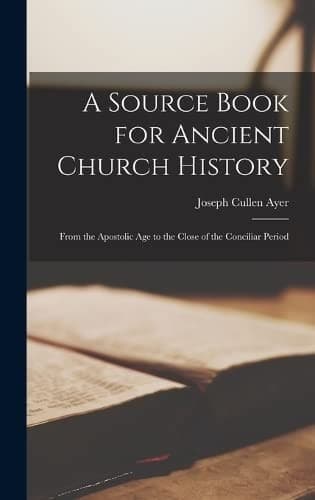
A Source Book for Ancient Church HistoryAyer, Joseph Cullen
History
A Source Book for Ancient Church History
Ayer, Joseph Cullen
Church history -- Primitive and early church, ca. 30-600 -- Sources
After the Decian-Valerian persecution (250-260) the Church enjoyed a long
peace, rarely interrupted anywhere by hostile measures, until the outbreak
of the second great general persecution, under Diocletian (303-313), a
space of over forty years. In this period the Church cast off the chiliasm
which had lingered as a part of a primitive Jewish conception of
Christianity (§ 47), and adapted itself to the actual condition of this
present world. Under the influence of scientific theology, especially that
of the Alexandrian school, the earlier forms of Monarchianism disappeared
from the Church, and the discussion began to narrow down to the position
which it eventually assumed in the Arian controversy (§ 48). Corresponding
to the development of the theology went that of the cultus of the Church,
and already in the West abiding characteristics appeared (§ 49). The
cultus and the disciplinary work of the bishops advanced in turn the
hierarchical organization of the Church and the place of the bishops (§
50), but the theory of local episcopal autonomy and the universalistic
tendencies of the see of Rome soon came into sharp conflict (§ 51),
especially over the validity of baptism administered by heretics (§ 52).
In this discussion the North African Church assumed a position which
subsequently became the occasion of the most serious schism of the ancient
Church, or Donatism. In this period, also, is to be set the rise of
Christian Monasticism as distinguished from ordinary Christian asceticism
(§ 53). At the same time, a dangerous rival of Christianity appeared in
the East, in the form of Manichæanism, in which were absorbed nearly all
the remnants of earlier Gnosticism (§ 54).
§ 47. The Chiliastic Controversy
During the third century the belief in chiliasm as a part of the Church’s
faith died out in nearly all parts of the Church. It did not seem called
for by the condition of the Church, which was rapidly adjusting itself to
the world in which it found itself. The scientific theology, especially
that of Alexandria, found no place in its system for such an article as
chiliasm. The belief lingered, however, in country places, and with it
went no little opposition to the “scientific” exegesis which by means of
allegory explained away the promises of a millennial kingdom. The only
account we have of this so-called “Chiliastic Controversy” is found in
connection with the history of the schism of Nepos in Egypt given by
Eusebius, But it may be safely assumed that the condition of things here
described was not peculiar to any one part of the Church, though an open
schism resulting from the conflict of the old and new ideas is not found
elsewhere.
Additional source material: Origen, _De Principiis_, II, 11 (ANF,
IV); Lactantius, _Divini Institutiones_, VII, 14-26 (ANF, VII);
Methodius, _Symposium_, IX, 5 (ANF, VI); _v. infra_, § 48.
Eusebius, _Hist. Ec._, VII, 24. (MSG, 20:693.)
Public-domain text, read in full here on John Shaqi.
Reviews
Reviews
No reviews yet
Be the first to share your thoughts on this work.
Elsewhere in the archive
Join the Discussion
Join the discussion
Sign in to leave a comment or review.
Sign InorCreate an account