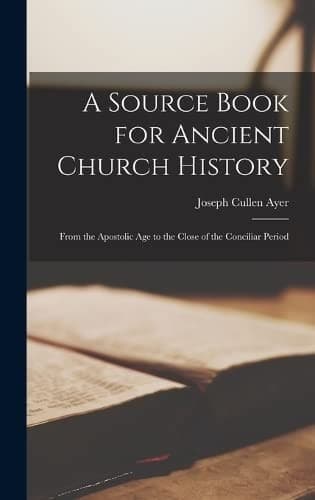
A Source Book for Ancient Church HistoryAyer, Joseph Cullen
History
A Source Book for Ancient Church History
Ayer, Joseph Cullen
Church history -- Primitive and early church, ca. 30-600 -- Sources
You must diligently observe and keep the practice delivered from divine
tradition and apostolic observance, which is also maintained among us, and
throughout almost all the provinces: that for the proper celebration of
ordinations all the neighboring bishops of the same province should
assemble with that people for which a prelate is ordained. And the bishops
should be chosen in the presence of the people, who have most fully known
the life of each one, and have looked into the doings of each one as
respects his manner of life. And this also, we see, was done by you in the
ordination of our colleague Sabinus; so that, by the suffrage of the whole
brotherhood, and by the sentence of the bishops who had assembled in their
presence, and who had written letters to you concerning him, the
episcopate was conferred upon him, and hands were imposed on him in the
place of Basilides. Neither can an ordination properly completed be
annulled, so that Basilides, after his crimes had been discovered and his
conscience made bare, even by his own confession, might go to Rome and
deceive Stephen, our colleague, who was placed at a distance and was
ignorant of what had been done, so as to bring it about that he might be
replaced unjustly in the episcopate from which he had been justly deposed.
§ 51. The Unity of the Church and the See of Rome
In the middle of the third century there were in sharp conflict two
distinct and opposed theories of Church unity: the theory that the unity
was based upon adherence to and conformity with the see of Peter; and the
theory that the episcopate was itself one, and that each bishop shared
equally in it. The unity was either in one see or in the less tangible
unity of an order of the hierarchy. The former was the theory of the Roman
bishops; the latter, the theory of Cyprian of Carthage, and possibly of a
number of other ecclesiastics in North Africa and Asia Minor. Formerly
polemical theology made the study of this point difficult, at least with
anything like impartiality. In the passage given below from Cyprian’s
treatise _On the Unity of the Catholic Church_ the text of the Jesuit
Father Kirch is followed in the most difficult and interpolated chapter 4.
As Father Kirch gives the text it is perfectly consistent with the theory
of Cyprian as he has elsewhere stated it, and that the interpolated text
is not. See, however, P. Battifol, _Primitive Catholicism_, Lond., 1911,
Excursus E.
Additional source material: _V. supra_, § 27; also Mirbt, §§
56-69. The little treatise _De Aleatoribus_ (MSL, 4: 827), from
which Mirbt gives an extract (n. 71), might be cited in this
connection, but its force depends upon its origin. It is wholly
uncertain that it was written either by a bishop of Rome or in
Italy. _Cf._ Bardenhewer. Kirch also gives the text in part, n.
276; for other references, see Kirch.
(_a_) Cyprian, _De Catholicæ Ecclesiæ Unitate_, 4, 5. (MSL, 4:513.)
Public-domain text, read in full here on John Shaqi.
Reviews
Reviews
No reviews yet
Be the first to share your thoughts on this work.
Elsewhere in the archive
Join the Discussion
Join the discussion
Sign in to leave a comment or review.
Sign InorCreate an account