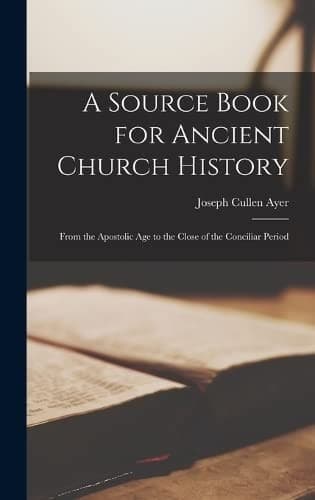
A Source Book for Ancient Church HistoryAyer, Joseph Cullen
History
A Source Book for Ancient Church History
Ayer, Joseph Cullen
Church history -- Primitive and early church, ca. 30-600 -- Sources
When Diocletian, the author of crimes and deviser of evils, was ruining
all things, not even from against God could he withhold his hand. This
man, partly by avarice and partly by timidity, overturned the world. For
he made three persons sharers with him in the government. The Empire was
divided into four parts, and armies were multiplied, since each of the
four princes strove to have a much larger military force than any emperor
had had when one emperor alone carried on the government. There began to
be a greater number of those who received taxes than of those who paid
them; so that the means of the husbandmen were exhausted by enormous
impositions, the fields were abandoned, and cultivated grounds became
woodlands, and universal dismay prevailed. Besides, the provinces were
divided into minute portions and many presidents and prefects lay heavy on
each territory, and almost on every city. There were many stewards and
masters and deputy presidents, before whom very few civil causes came, but
only condemnations and frequent forfeitures, and exactions of numberless
commodities, and I will not say often repeated, but perpetual and
intolerable, wrongs in the exacting of them.
§ 56. The Diocletian Persecution
The last great persecution was preceded by a number of laws aimed to annoy
the Christians. On March 12, 295, all soldiers in the army were ordered to
offer sacrifice. In 296 sacred books of the Christians were sought for and
burnt at Alexandria. In 297 or 298 Christian persecutions began in the
army, but the great persecution itself broke out in 303, as described
below. Among other reasons for energetic measures in which Galerius took
the lead, appears to have been that prince’s desire to establish the unity
of the Empire upon a religious basis, which is borne out by his attempts
to reorganize the heathen worship immediately after the cessation of the
persecution. In April, 311, the edict of Galerius, known as the Edict of
the Three Emperors, put an official end to the persecution. In parts of
the Empire, however, small persecutions took place and the authorities
attempted to attack Christianity without actually carrying on
persecutions, as in the wide-spread dissemination of the infamous “Acts of
Pilate,” which were posted on walls and spread through the schools. In the
territories of Constantius Chlorus the persecution had been very light,
and there was none under Constantine who favored Christians from the
first.
Additional source material: Eusebius, _Hist. Ec._, VIII, and IX,
9; his little work _On the Martyrs of Palestine_ will be found
after the eighth book. Lactantius, _De Mortibus Persecutorum_. The
principal texts will be found in Preuschen’s _Analecta_, I, §§ 20,
21; see also R. Knopf, _Ausgewählte Märtyreracten_.
(_a_) Lactantius. _De Mortibus Persecutorum_, 12 _ff_. (MSL. 7:213.)
The outbreak of the persecution.
Public-domain text, read in full here on John Shaqi.
Reviews
Reviews
No reviews yet
Be the first to share your thoughts on this work.
Elsewhere in the archive
Join the Discussion
Join the discussion
Sign in to leave a comment or review.
Sign InorCreate an account