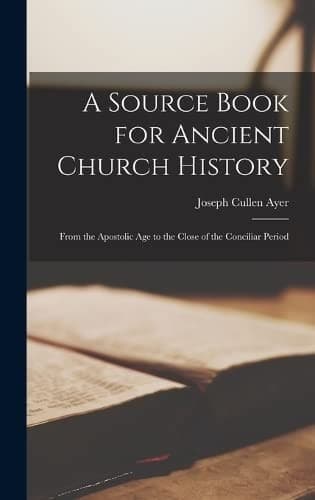
A Source Book for Ancient Church HistoryAyer, Joseph Cullen
History
A Source Book for Ancient Church History
Ayer, Joseph Cullen
Church history -- Primitive and early church, ca. 30-600 -- Sources
The Arian controversy began in Alexandria about 318, as related by
Socrates (_a_). The positions of the two parties were defined from the
beginning both by Alexander, bishop of Alexandria (_b_), and Arius himself
(_c_), who by appealing to Eusebius of Nicomedia, his fellow-student in
the school of Lucian of Antioch, enlisted the support of that able
ecclesiastical politician and courtier and at once extended the area of
the controversy throughout the East. By means of poems of a somewhat
popular character entitled the _Thalia_, about 322 (_d_), Arius spread his
doctrines still further, involving others than the trained professional
theologian. In the meanwhile Arius and some other clergy sympathizing with
him in Egypt were deposed about 320 (_e_). Constantine endeavored to end
the dispute by a letter, and, failing in this, sent Hosius of Cordova, his
adviser in ecclesiastical matters, to Alexandria in 324. On the advice of
Hosius, a synod was called to meet at Nicæa in the next year, after the
pattern of the earlier synod for the West at Arles in 314. Here the basis
for a definition of faith was a non-committal creed presented by Eusebius
of Cæsarea, the Church historian (_f_). This was modified, probably under
the influence of Hosius, so as to be in harmony at once with the tenets of
the party of Alexander and Athanasius, and with the characteristic
theology of the West (_g_).
Additional source material: J. Chrystal, _Authoritative
Christianity_, Jersey City, 1891, vol. I; _The Council of Nicæa:
The Genuine Remains_; H. R. Percival, _The Seven Ecumenical
Councils_ (PNF, ser. II, vol. XIV); Athanasius, _On the
Incarnation_ (PNF, ser. II, vol. IV).
(_a_) Socrates. _Hist. Ec._, I, 5. (MSG, 67:41.)
The outbreak of the controversy at Alexandria circa 318.
After Peter, who was bishop of Alexandria, had suffered martyrdom under
Diocletian, Achillas succeeded to the episcopal office, and after
Achillas, Alexander succeeded in the period of peace above referred to.
Conducting himself fearlessly, he united the Church. By chance, one day,
in the presence of the presbyters and the rest of his clergy, he was
discussing too ambitiously the doctrine of the Holy Trinity, teaching that
there was a unity in the Trinity. But Arius, one of the presbyters under
his jurisdiction, a man of no inconsiderable logical acumen, imagining
that the bishop was subtly introducing the doctrine of Sabellius the
Libyan, from the love of controversy took the opposite opinion to that of
the Libyan, and, as he thought, vigorously responded to the things said by
the bishop. “If,” said he, “the Father begat the Son, He that was begotten
had a beginning of existence; and from this it is evident that there was a
time when the Son was not. It follows necessarily that He had His
subsistence [hypostasis] from nothing.”
(_b_) Alexander of Alexandria. _Ep. ad Alexandrum_, in Theodoret, _Hist.
Ec._, I, 3. (MSG, 88:904.)
Public-domain text, read in full here on John Shaqi.
Reviews
Reviews
No reviews yet
Be the first to share your thoughts on this work.
Elsewhere in the archive
Join the Discussion
Join the discussion
Sign in to leave a comment or review.
Sign InorCreate an account