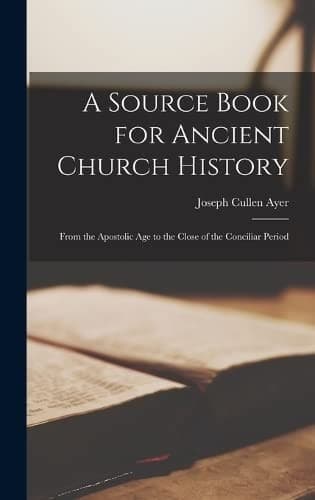
A Source Book for Ancient Church HistoryAyer, Joseph Cullen
History
A Source Book for Ancient Church History
Ayer, Joseph Cullen
Church history -- Primitive and early church, ca. 30-600 -- Sources
(_g_) Council of Nicæa A. D. 325, _Creed_, in Socrates, _Hist. Ec._, I, 8.
(MSG, 67:68.) _Cf._ Hahn, § 142.
The creed of Nicæa is to be carefully distinguished from what is
commonly called the Nicene creed. The actual creed put forth at
the council is as follows. The discussion by Loofs,
_Dogmengeschichte_, § 32, is brief but especially important, as he
shows that the creed was drawn up under the influence of the
Western formulæ.
We believe in one God, Father Almighty, maker of all things visible and
invisible; and in one Lord Jesus Christ, the Son of God, begotten of His
Father, only begotten, that is of the _ousia_ of the Father, God of God,
Light of Light, true God of true God; begotten, not made, of one
substance(104) with the Father, by whom all things were made, both things
in heaven and things in earth, who for us men and for our salvation, came
down from heaven and was made [became] flesh and was made [became] man,
suffered and rose again on the third day, ascended into the heavens and
comes to judge living and dead. And in the Holy Ghost.
But those who say there was when He was not, and before being begotten He
was not, and He was made out of things that were not(105) or those who say
that the Son of God was from a different substance [hypostasis] or being
[_ousia_] or a creature, or capable of change or alteration, these the
Catholic Church anathematizes.
§ 64. The Beginnings of the Eusebian Reaction under Constantine
Shortly after the Council of Nicæa, Constantine seems to have become aware
of the fact that the decision at that council was not acceptable in the
East as a whole, representing, as it did, what was generally felt to be an
extreme position. In coming to this opinion he was much influenced by
Eusebius of Nicomedia who, by powerful court interest, was soon recalled
from exile and even became the leading ecclesiastical adviser of
Constantine. The policy of this bishop was to prepare the way for the
revocation of the decree of Nicæa by a preliminary rehabilitation of Arius
(_a_), and by attacking the leaders of the opposite party (_b_).
Constantine, however, never consented to the abrogation of the creed of
Nicæa.
Additional source material: Socrates, _Hist. Ec._, I, 8 (letter of
Eusebius to his diocese), 14, 28 ff. _Eusebius, Vita Constantini_,
III, 23; Athanasius, _Historia Arianorum_, §§ 4-7.
(_a_) Arius, _Confession of Faith_, in Socrates, _Hist. Ec._, I, 26. (MSG,
67:149.)
As a part of the process whereby Arius should be rehabilitated by
being received back into the Church he was invited by Constantine
to appear at the court. He was there presented to the Emperor and
produced a confession of faith purposely vague and general in
statement, but intended to give the impression that he held the
essentials of the received orthodoxy. The text is that given by
Hahn, § 187.
Public-domain text, read in full here on John Shaqi.
Reviews
Reviews
No reviews yet
Be the first to share your thoughts on this work.
Elsewhere in the archive
Join the Discussion
Join the discussion
Sign in to leave a comment or review.
Sign InorCreate an account