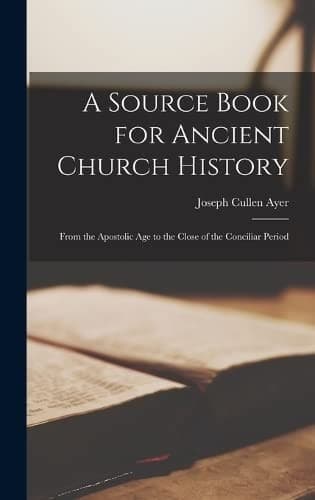
A Source Book for Ancient Church HistoryAyer, Joseph Cullen
History
A Source Book for Ancient Church History
Ayer, Joseph Cullen
Church history -- Primitive and early church, ca. 30-600 -- Sources
A wide-spread opinion that Gnosticism was fundamentally a
perversion of Christianity finds its most striking expression in
the phrase of Harnack that it was “the acute secularizing or
Hellenizing of Christianity” (_History of Dogma_, English
translation, I, 226). The foundation for this representation is
the later Gnosticism, which took over many Christian and Greek
elements, and the opinion of Tertullian that Gnosticism and Greek
philosophy discussed the same questions and held the same
opinions. (_Cf._ the thesis of Hippolytus in his _Philosophumena,
or the Refutation of All Heresies_; see the Proemium, ANF, V, 9
_f._, and especially bk. VII.) Tertullian, although retaining
unconsciously the impress of his former Stoicism, was violently
opposed to philosophy, and in his denunciation of heresy felt that
it was a powerful argument against the Gnostics to show
similarities between their teaching and the Greek philosophy he so
heartily detested. It is a brilliant work and may be taken as a
fair specimen of Tertullian’s style.
These are the doctrines of men and of demons born of the spirit of this
world’s wisdom, for itching ears; and the Lord, calling this foolishness,
chose the foolish things of this world to the confusion of philosophy
itself. For philosophy is the material of the world’s wisdom, the rash
interpreter of the nature and dispensation of God. Indeed, heresies
themselves are instigated by philosophy. From this source came the eons,
and I know not what infinite forms, and the trinity of man in the system
of Valentinus; he was of Plato’s school. From this source came Marcion’s
better god with all his tranquillity; he came of the Stoics. Then again
the opinion that the soul dies is held by the Epicureans. The denial of
the resurrection of the body is taken from the united schools of all
philosophers. When matter is made equal to God, you have the teaching of
Zeno; and when anything is alleged touching a fiery god, then Heraclitus
comes in. The same subject-matter is discussed over and over again by the
heretics and the philosophers; the same arguments are involved. Whence and
wherefore is evil? Whence and how has come man? Besides these there is the
question which Valentinus has very recently proposed, Whence comes God?
(_b_) Irenæus, _Adv. Hær._, I, 23. (MSG, 7:670.)
Simon Magus. For additional source material, see Justin Martyr,
_Apol._ I, 26, 56, _Dial. c. Tryph._, 120; Hippolytus, _Ref._ VI,
72 _f._ The appearance of Simon in the pseudo-Clementine
literature (translated in ANF, VIII), presents an interesting
historical problem. The present condition of investigation is
given in the article “Clementine Literature” by J. V. Bartlett, in
_Encyc. Brit._, eleventh ed.
Public-domain text, read in full here on John Shaqi.
Reviews
Reviews
No reviews yet
Be the first to share your thoughts on this work.
Join the Discussion
Join the discussion
Sign in to leave a comment or review.
Sign InorCreate an account