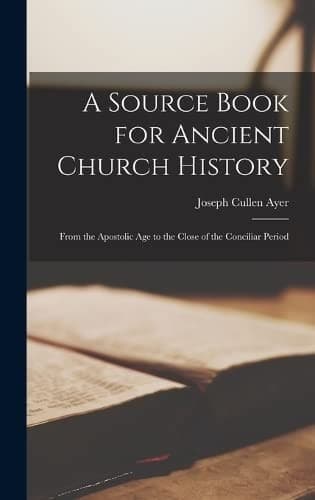
A Source Book for Ancient Church HistoryAyer, Joseph Cullen
History
A Source Book for Ancient Church History
Ayer, Joseph Cullen
Church history -- Primitive and early church, ca. 30-600 -- Sources
Simon the Samaritan, that magician of whom Luke, the disciple and follower
of the Apostles, says: “But there was a certain man, Simon by name,” etc.
[Acts 8:9-11, 20, 21, 23.] Since he did not put his faith in God a whit
more, he set himself eagerly to contend against the Apostles, in order
that he himself might seem to be a wonderful being, and studied with still
greater zeal the whole range of magic art, that he might the better
bewilder the multitude of men. Such was his procedure in the reign of
Claudius Cæsar, by whom also he is said to have been honored with a statue
on account of his magic. This man, then, was glorified by many as a god,
and he taught that it was he himself who appeared among the Jews as the
Son, but descended in Samaria as the Father, while he came to other
nations in the character of the Holy Spirit. He represented himself as the
loftiest of all powers, that it is he who is over all as the Father, and
he allowed himself to be called whatsoever men might name him.
Now this Simon of Samaria, from whom all heresies derive their origin, has
as the material for his sect the following: Having redeemed from slavery
at Tyre, a city of Phœnicia, a certain woman named Helena,(38) a
prostitute, he was in the habit of carrying her about with him, declaring
that she was the first conception [_Ennœa_] of his mind, the mother of
all, by whom he conceived in his mind to make the angels and archangels.
For this Ennœa, leaping forth from him and comprehending the will of her
father, descended to the lower regions and generated angels and powers, by
whom, also, he declared this world was made. But after she had generated
them she was detained by them through jealousy, because they were
unwilling that they should be regarded as the progeny of any other being.
As to himself, he was wholly unknown to them, but his Ennœa was detained
by those powers and angels who had been produced by her. She suffered all
kinds of contumely from them, so that she could not return upward to her
father, but was even shut up in a human body and for ages passed in
succession from one female body to another, as from one vessel to another
vessel. She was in that Helen on whose account the Trojan War was
undertaken; wherefore also Stesichorus was struck blind, because he cursed
her in his poems; but afterward, when he had repented and written those
verses which are called palinodes, in which he sung her praises, he saw
once more. Thus passing from body to body and suffering insults in every
one of them, she at last became a common prostitute; and she it is who was
the lost sheep.
Public-domain text, read in full here on John Shaqi.
Reviews
Reviews
No reviews yet
Be the first to share your thoughts on this work.
Elsewhere in the archive
Join the Discussion
Join the discussion
Sign in to leave a comment or review.
Sign InorCreate an account