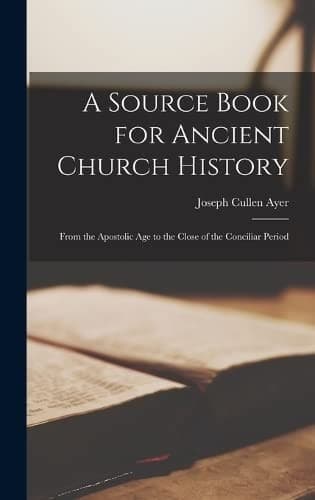
A Source Book for Ancient Church HistoryAyer, Joseph Cullen
History
A Source Book for Ancient Church History
Ayer, Joseph Cullen
Church history -- Primitive and early church, ca. 30-600 -- Sources
Among the Persians there was also a certain preacher, one Basilides, of
more ancient date, not long after the time of our Apostles. Since he was
of a shrewd disposition himself, and observed that at that time all other
subjects were preoccupied, he determined to affirm that dualism which was
maintained also by Scythianus. And so, since he had nothing to advance
which he might call his own, he brought the sayings of others before his
adversaries. And all his books contain some matters difficult and
extremely harsh. The thirteenth book of his Tractates,(39) however, is
still extant, which begins thus: “In writing the thirteenth book of our
Tractates, the word of salvation furnished us with the necessary and
fruitful word. It illustrates(40) under the figure of a rich [principle]
and a poor [principle], a nature without root and without place and only
supervenes upon things.(41) This is the only topic which the book
contains.” Does it not, then, contain a strange word, as also certain
persons think? Will ye not all be offended with the book itself, of which
this is the beginning? But Basilides, returning to the subject, some five
hundred lines intervening, more or less, says: “Give up this vain and
curious variation, and let us rather find out what inquiries the
Barbarians [_i.e._, the Persians] have instituted concerning good and
evil, and to what opinions they have come on all these subjects. For
certain among them have said that there are for all things two beginnings
[or principles], to which they have referred good and evil, holding these
principles are without beginning and ingenerate; that is to say, that in
the origins of things there were light and darkness, which existed of
themselves, and which were not declared to exist.(42) When these subsisted
by themselves, they each led its own proper mode of life as it willed to
lead, and such as was competent to it. For in the case of all things, what
is proper to it is in amity with it, and nothing seems evil to itself. But
after they came to the knowledge of each other, and after the darkness
contemplated the light, then, as if fired with a passion for something
superior, the darkness rushed to have intercourse with the light.”
(_b_) Clement of Alexandria, _Strom._, IV, 12. (MSG, 8:1289.)
Public-domain text, read in full here on John Shaqi.
Reviews
Reviews
No reviews yet
Be the first to share your thoughts on this work.
Elsewhere in the archive
Join the Discussion
Join the discussion
Sign in to leave a comment or review.
Sign InorCreate an account