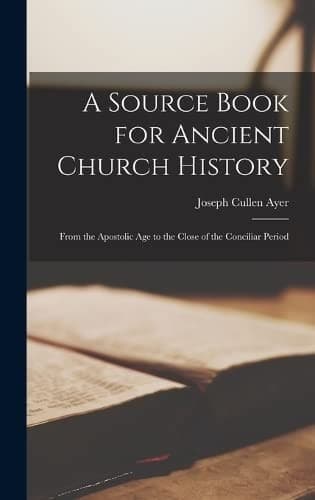
A Source Book for Ancient Church HistoryAyer, Joseph Cullen
History
A Source Book for Ancient Church History
Ayer, Joseph Cullen
Church history -- Primitive and early church, ca. 30-600 -- Sources
IV, 3. Well, but because Marcion finds the Epistle to the Galatians by
Paul, who rebukes even Apostles for “not walking uprightly according to
the truth of the Gospel” [Gal. 2:14], as well as accuses certain false
apostles of being perverters of the Gospel of Christ, he attempts to
destroy the standing of those gospels which are published as genuine and
under the names of Apostles, or of apostolic men, to secure, forsooth, for
his own gospel the credit he takes away from them.
(_c_) Rhodon, in Eusebius, _Hist. Ec._, V, 13. (MSG, 20:459.)
At this time Rhodon, a native of Asia, who, as he himself states, had been
instructed at Rome by Tatian, with whom we have already become acquainted,
wrote excellent books, and published among the rest one against the heresy
of Marcion which, he says, was in his time divided into various sects; and
he describes those who occasioned the division and refutes carefully the
falsehood devised by each. But hear what he writes: “Therefore also they
have fallen into disagreement among themselves, and maintain inconsistent
opinions. For Apelles, one of their herd, priding himself on his manner of
life and his age, acknowledged one principle [_i.e._, source of
existence], but says that the prophecies were from an opposing spirit. And
he was persuaded of the truth of this by the responses of a demoniac
maiden named Philumene. But others hold to two principles, as does the
mariner Marcion himself, among these are Potitus and Basiliscus. These,
following the wolf of Pontus and, like him, unable to discover the
divisions of things, became reckless, and without any proof baldly
asserted two principles. Again, others of them drifted into worse error
and assumed not only two, but three, natures. Of these Syneros is the
leader and chief, as those say who defend his teaching.”
§ 24. Encratites
Asceticism is a wide-spread phenomenon in nearly all religions. It is to
be found in apostolic Christianity. In the early Church it was regarded as
a matter in the option of the Christian who was aiming at the religious
life [see above, § 16]. The characteristic of the Encratites was their
insistence upon asceticism as essential to Christian living. They were
therefore associated, and with abundant historical justification, with
Gnosticism.
Additional source material: Clement of Alexandria, _Strom._, III,
_passim_; Eusebius, _Hist. Ec._, IV, 29, _cf._ the many references
in the notes to McGiffert’s edition, PNF.
(_a_) Hippolytus, VIII, 13. (MSG, 16:3368.)
See above, § 19, _c_.
Others, however, styling themselves Encratites, acknowledge some things
concerning God and Christ in like manner with the Church, but in respect
to their mode of life they pass their time inflated with pride; thinking
that by meats they glorify themselves, they abstain from animal food, are
water drinkers, and, forbidding to marry, they devote the rest of their
life to habits of asceticism.
Public-domain text, read in full here on John Shaqi.
Reviews
Reviews
No reviews yet
Be the first to share your thoughts on this work.
Elsewhere in the archive
Join the Discussion
Join the discussion
Sign in to leave a comment or review.
Sign InorCreate an account