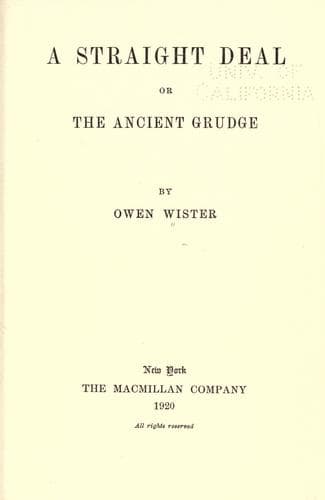
A Straight Deal; Or, The Ancient GrudgeWister, Owen
History
A Straight Deal; Or, The Ancient Grudge
Wister, Owen
Great Britain -- Relations -- United States; United States -- Relations -- Great Britain
Besides John Bright and Cobden, we had other English friends of
influence and celebrity: John Stuart Mill, Thomas Hughes, Goldwin Smith,
Leslie Stephen, Robert Gladstone, Frederic Harrison are some of them.
All from the first supported us. All from the first worked and spoke for
us. The Union and Emancipation Society was founded. “Your Committee,”
says its final report when the war was ended, “have issued and
circulated upwards of four hundred thousand books, pamphlets, and
tracts... and nearly five hundred official and public meetings have
been held...” The president of this Society, Mr. Potter, spent thirty
thousand dollars in the cause, and at a time when times were hard and
fortunes as well as cotton-spinners in distress through our blockade.
Another member of the Society, Mr. Thompson, writes of one of the public
meetings: “... I addressed a crowded assembly of unemployed operatives
in the town of Heywood, near Manchester, and spoke to them for two hours
about the Slaveholders’ Rebellion. They were united and vociferous in
the expression of their willingness to suffer all hardships consequent
upon a want of cotton, if thereby the liberty of the victims of Southern
despotism might be promoted. All honor to the half million of our
working population in Lancashire, Cheshire, and elsewhere, who are
bearing with heroic fortitude the privation which your war has entailed
upon them!... Their sublime resignation, their self-forgetfulness,
their observance of law, their whole-souled love of the cause of human
freedom, their quick and clear perception of the merits of the question
between the North and the South... are extorting the admiration of all
classes of the community ...”
How much of all this do you ever hear from the people who remember the
Alabama?
Strictly in accord with Beecher’s vivid summary of the true England in
our Civil War, are some passages of a letter from Mr. John Bigelow, who
was at that time our Consul-General at Paris, and whose impressions,
written to our Secretary of State, Mr. Seward, on February 6, 1863, are
interesting to compare with what Beecher says in that letter, from which
I have already given extracts.
Public-domain text, read in full here on John Shaqi.
Reviews
Reviews
No reviews yet
Be the first to share your thoughts on this work.
Join the Discussion
Join the discussion
Sign in to leave a comment or review.
Sign InorCreate an account