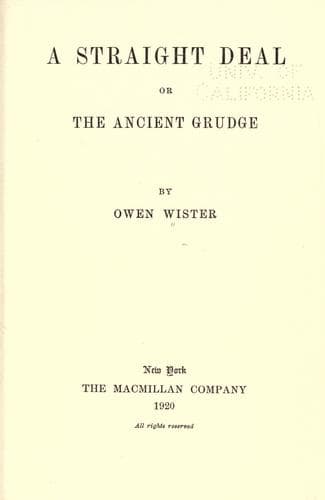
A Straight Deal; Or, The Ancient GrudgeWister, Owen
History
A Straight Deal; Or, The Ancient Grudge
Wister, Owen
Great Britain -- Relations -- United States; United States -- Relations -- Great Britain
“The anti-slavery meetings in England are having their effect upon the
Government already... The Paris correspondent of the London Post also
came to my house on Wednesday evening... He says... that there are about
a dozen persons who by their position and influence over the organs
of public opinion have produced all the bad feeling and treacherous
con-duct of England towards America. They are people who, as members of
the Government in times past, have been bullied by the U. S.... They are
not entirely ignorant that the class who are now trying to overthrow the
Government were mainly responsible for the brutality, but they think we
as a nation are disposed to bully, and they are disposed to assist in
any policy that may dismember and weaken us. These scars of wounded
pride, however, have been carefully concealed from the public, who
therefore cannot be readily made to see why, when the President has
distinctly made the issue between slave labor and free labor, that
England should not go with the North. He says these dozen people who
rule England hate us cordially... ”
There were more than a dozen, a good many more, as we know from Charles
and Henry Adams. But read once again the last paragraph of Beecher’s
letter, and note how it corresponds with what Mr. Bigelow says about the
feeling which our Government (for thirty years “in the hands or under
the influence of Southern statesmen”) had raised against us by its bad
manners to European governments. This was the harvest sown by shirt
sleeves diplomacy and reaped by Mr. Adams in 1861. Only seven years
before, we had gratuitously offended four countries at once. Three of
our foreign ministers (two of them from the South) had met at Ostend
and later at Aix in the interests of extending slavery, and there, in
a joint manifesto, had ordered Spain to sell us Cuba, or we would take
Cuba by force. One of the three was our minister to Spain. Spain had
received him courteously as the representative of a nation with whom she
was at peace. It was like ringing the doorbell of an acquaintance, being
shown into the parlor and telling him he must sell you his spoons or you
would snatch them. This doesn’t incline your neighbor to like you. But,
as has been said, Mr. Adams was an American who did know how to behave,
and thereby served us well in our hour of need.
Public-domain text, read in full here on John Shaqi.
Reviews
Reviews
No reviews yet
Be the first to share your thoughts on this work.
Join the Discussion
Join the discussion
Sign in to leave a comment or review.
Sign InorCreate an account