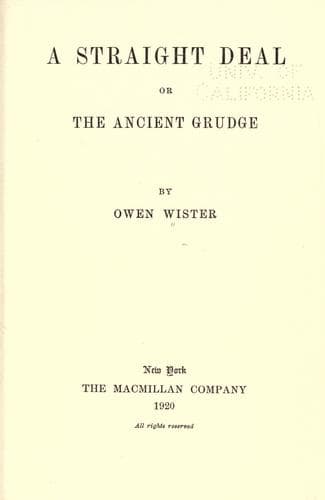
A Straight Deal; Or, The Ancient GrudgeWister, Owen
History
A Straight Deal; Or, The Ancient Grudge
Wister, Owen
Great Britain -- Relations -- United States; United States -- Relations -- Great Britain
During 1917-1918 Britain’s armies held the enemy in three continents and
on six fronts, and cooperated with her Allies on two more fronts.
Her dead, those six hundred and fifty-eight thousand dead, lay by the
Tigris, the Zambesi, the AEgean, and across the world to Flanders’
fields. Between March 21st and April 17th, 1918, the Huns in their
drive used 127 divisions, and of these 102 were concentrated against
the British. That was in Flanders. Britain, at the same time she was
fighting in Flanders, had also at various times shared in the fighting
in Russia, Kiaochau, New Guinea, Samoa, Mesopotamia, Palestine,
Egypt, the Sudan, Cameroons, Togoland, East Africa, South West Africa,
Saloniki, Aden, Persia, and the northwest frontier of India. Britain
cleared twelve hundred thousand square miles of the enemy in
German colonies. While fighting in Mesopotamia, her soldiers were
reconstructing at the same time. They reclaimed and cultivated more than
1100 square miles of land there, which produced in consequence enough
food to save two million tons of shipping annually for the Allies. In
Palestine and Mesopotamia alone, British troops in 1917 took 23,590
prisoners. In 1918, in Palestine from September 18th to October 7th,
they took 79,000 prisoners.
What did England do in the war, anyhow?
With “French’s contemptible little army” she saved France at the
start--but I’ll skip that--except to mention that one division lost
10,000 out of 12,000 men, and 350 out of 400 officers. At Zeebrugge and
Ostend--do not forget the Vindictive--she dealt with submarines in April
and May, 1918--but I’ll skip that; I cannot set down all that she did,
either at the start, or nearing the finish, or at any particular moment
during those four years and three months that she was helping to hold
Germany off from the throat of the world; it would make a very thick
book. But I am giving you enough, I think, wherewith to answer the
ignorant, and the frauds, and the fools. Tell them that from 1916 to
1918 Great Britain increased her tillage area by four million acres:
wheat 39 per cent, barley 11, oats 35, potatoes 50--in spite of the
shortage of labor. She used wounded soldiers, college boys and girls,
boy scouts, refugees, and she produced the biggest grain crop in fifty
years. She started fourteen hundred thousand new war gardens; most
of those who worked them had worked already a long day in a munition
factory. These devoted workers increased the potato crop in 1917 by
three million tons--and thus released British provision ships to
carry our soldiers across. In that Boston speech which one of my
correspondents referred to, our Secretary of the Navy did not mention
this. Mention it yourself. And tell them about the boy scouts and the
women. Fifteen thousand of the boy scouts joined the colors, and over
fifty thousand of the younger members served in various ways at home.
Public-domain text, read in full here on John Shaqi.
Reviews
Reviews
No reviews yet
Be the first to share your thoughts on this work.
Elsewhere in the archive
Join the Discussion
Join the discussion
Sign in to leave a comment or review.
Sign InorCreate an account