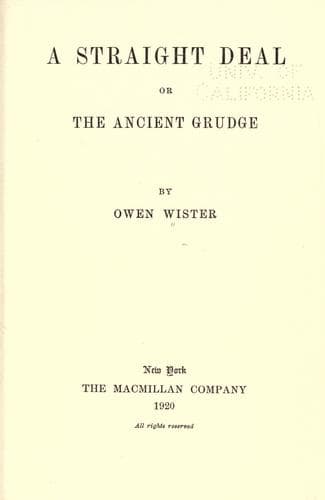
A Straight Deal; Or, The Ancient GrudgeWister, Owen
History
A Straight Deal; Or, The Ancient Grudge
Wister, Owen
Great Britain -- Relations -- United States; United States -- Relations -- Great Britain
Of England’s women seven million were engaged in work on munitions and
other necessaries and apparatus of war. The terrible test of that second
battle of Ypres, to which I have made brief allusion above, wrought
an industrial revolution in the manufacture of shells. The energy
of production rose at a rate which may be indicated by two or three
comparisons: In 1917 as many heavy howitzer shells were turned out in a
single day as in the whole first year of the war, as many medium shells
in five days, and as many field-gun shells in eight days. Or in other
words, 45 times as many field-gun shells, 73 times as many medium, and
365 times as many heavy howitzer shells, were turned out in 1917 as in
the first year of the war. These shells were manufactured in buildings
totaling fifteen miles in length, forty feet in breadth, with more than
ten thousand machine tools driven by seventeen miles of shafting with an
energy of twenty-five thousand horse-power and a weekly output of over
ten thousand tons’ weight of projectiles--all this largely worked by
the women of England. While the fleet had increased its personnel
from 136,000 to about 400,000, and 2,000,000 men by July, 1915, had
voluntarily enlisted in the army before England gave up her birthright
and accepted compulsory service, the women of England left their
ordinary lives to fabricate the necessaries of war. They worked at home
while their husbands, brothers, and sons fought and died on six battle
fronts abroad--six hundred and fifty-eight thousand died, remember;
do you remember the number of Americans killed in action?--less than
thirty-six thousand;--those English women worked on, seven millions of
them at least, on milk carts, motor-busses, elevators, steam engines,
and in making ammunition. Never before had any woman worked on more than
150 of the 500 different processes that go to the making of munitions.
They now handled T. N. T., and fulminate of mercury, more deadly still;
helped build guns, gun carriages, and three-and-a-half ton army cannons;
worked overhead traveling cranes for moving the boilers of battleships:
turned lathes, made every part of an aeroplane. And who were these
seven million women? The eldest daughter of a duke and the daughter of a
general won distinction in advanced munition work. The only daughter of
an old Army family broke down after a year’s work in a base hospital
in France, was ordered six months’ rest at home, but after two months
entered a munition factory as an ordinary employee and after nine
months’ work had lost but five minutes working time. The mother of
seven enlisted sons went into munitions not to be behind them in serving
England, and one of them wrote her she was probably killing more Germans
than any of the family. The stewardess of a torpedoed passenger ship
was among the few survivors. Reaching land, she got a job at a capstan
lathe. Those were the seven million women of England--daughters of
Public-domain text, read in full here on John Shaqi.
Reviews
Reviews
No reviews yet
Be the first to share your thoughts on this work.
Elsewhere in the archive
Join the Discussion
Join the discussion
Sign in to leave a comment or review.
Sign InorCreate an account