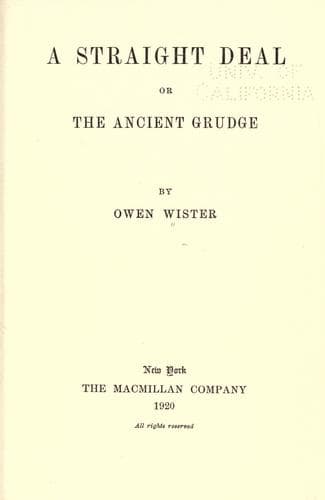
A Straight Deal; Or, The Ancient GrudgeWister, Owen
History
A Straight Deal; Or, The Ancient Grudge
Wister, Owen
Great Britain -- Relations -- United States; United States -- Relations -- Great Britain
It was after our present Secretary of the Navy, in his speech in Boston
to which allusion has been made, had given our navy all and the British
navy none of the credit of conveying our soldiers overseas, that Admiral
Sims repaired the singular oblivion of the Secretary. We Americans
should know the truth, he said. We had not been too accurately informed.
We did not seem to have been told by anybody, for instance, that of
the five thousand anti-submarine craft operating day and night in the
infested waters, we had 160, or 3 per cent; that of the million and a
half troops which had gone over from here in a few months, Great Britain
brought over two thirds and escorted half.
“I would like American papers to pay particular attention to the fact
that there are about 5000 anti-submarine craft in the ocean to-day,
cutting out mines, escorting troop ships, and making it possible for us
to go ahead and win this war. They can do this because the British Grand
Fleet is so powerful that the German High Seas Fleet has to stay at
home. The British Grand Fleet is the foundation stone of the cause of
the whole of the Allies.”
Thus Admiral Sims.
That is part of what England did in the war.
Note.--The author expresses thanks and acknowledgment to Pearson’s
Magazine for permission to use the passages quoted from the articles by
Admiral Sims.
Chapter XV: Rude Britannia, Crude Columbia
It may have been ten years ago, it may have been fifteen--and just
how long it was before the war makes no matter--that I received
an invitation to join a society for the promotion of more friendly
relations between the United States and England.
“No, indeed,” I said to myself.
Even as I read the note, hostility rose in me. Refusal sprang to my lips
before my reason had acted at all. I remembered George III. I remembered
the Civil War. The ancient grudge, the anti-English complex, had been
instantly set fermenting in me. Nothing could better disclose its
lurking persistence than my virtually automatic exclamation, “No,
indeed!” I knew something about England’s friendly acts, about
Venezuela, and Manila Bay, and Edmund Burke, and John Bright, and the
Queen, and the Lancashire cotton spinners. And more than this historic
knowledge, I knew living English people, men and women, among whom I
counted dear and even beloved friends. I knew also, just as well as
Admiral Mahan knew, and other Americans by the hundreds of thousands
have known and know at this moment, that all the best we have and
are--law, ethics, love of liberty--all of it came from England, grew in
England first, ripened from the seed of which we are merely one great
harvest, planted here by England. And yet I instantly exclaimed, “No,
indeed!”
Public-domain text, read in full here on John Shaqi.
Reviews
Reviews
No reviews yet
Be the first to share your thoughts on this work.
Elsewhere in the archive
Join the Discussion
Join the discussion
Sign in to leave a comment or review.
Sign InorCreate an account