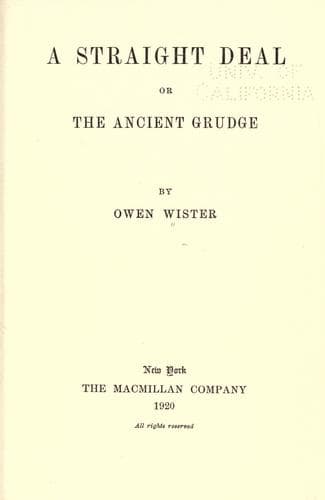
A Straight Deal; Or, The Ancient GrudgeWister, Owen
History
A Straight Deal; Or, The Ancient Grudge
Wister, Owen
Great Britain -- Relations -- United States; United States -- Relations -- Great Britain
But again, you most naturally object, there was nothing personal in my
friend’s question about the buildings. No; but that is not it. At
the bottom, both questions are an invasion of the same deep-seated
thing--the right to privacy. In America, what with the newspaper
reporters and this and that and the other, the territory of a man’s
privacy has been lessened and lessened until very little of it remains;
but most of us still do draw the line somewhere; we may not all draw it
at the same place, but we do draw a line. The difference, then, between
ourselves and the English in this respect is simply, that with them the
territory of a man’s privacy covers more ground, and different ground as
well. An Englishman doesn’t expect strangers to ask him questions of
a guide-book sort. For all such questions his English system provides
perfectly definite persons to answer. If you want to know where the
ticket office is, or where to take your baggage, or what time the train
goes, or what platform it starts from, or what towns it stops at, and
what churches or other buildings of interest are to be seen in those
towns, there are porters and guards and Bradshaws and guidebooks to
tell you, and it’s they whom you are expected to consult, not any
fellow-traveler who happens to be at hand. If you ask him, you break the
rules. Had my friend said: “I am an American. Would you mind telling
me what those buildings are?” all would have gone well. The Englishman
would have recognized (not fifty years ago, but certainly to-day) that
it wasn’t a question of rules between them, and would have at once
explained--either that he didn’t know, or that the buildings were such
and such.
Do not, I beg, suppose for a moment that I am holding up the English
way as better than our own--or worse. I am not making comparisons; I am
trying to show differences. Very likely there are many points wherein
we think the English might do well to borrow from us; and it is quite as
likely that the English think we might here and there take a leaf from
their book to our advantage. But I am not theorizing, I am not seeking
to show that we manage life better or that they manage life better; the
only moral that I seek to draw from these anecdotes is, that we should
each understand and hence make allowance for the other fellow’s way. You
will admit, I am sure, be you American or English, that everybody has
a right to his own way? The proverb “When in Rome you must do as Rome
does” covers it, and would save trouble if we always obeyed it. The
people who forget it most are they that go to Rome for the first
time; and I shall give you both English and American examples of this
presently. It is good to ascertain before you go to Rome, if you can,
what Rome does do.
Public-domain text, read in full here on John Shaqi.
Reviews
Reviews
No reviews yet
Be the first to share your thoughts on this work.
Elsewhere in the archive
Join the Discussion
Join the discussion
Sign in to leave a comment or review.
Sign InorCreate an account