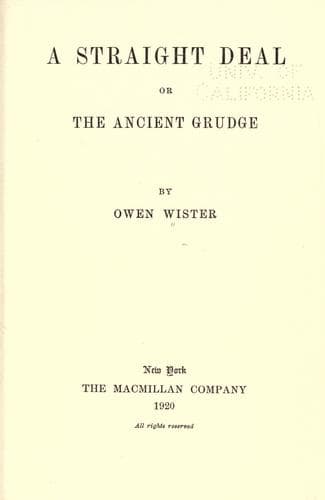
A Straight Deal; Or, The Ancient GrudgeWister, Owen
History
A Straight Deal; Or, The Ancient Grudge
Wister, Owen
Great Britain -- Relations -- United States; United States -- Relations -- Great Britain
About 1874 a friend of mine from New York was taken to a London Club.
Into the room where he was came the Prince of Wales, who took out a
cigar, felt for and found no matches, looked about, and there was a
silence. My friend thereupon produced matches, struck one, and offered
it to the Prince, who bowed, thanked him, lighted his cigar, and
presently went away.
Then an Englishman observed to my friend: “It’s not the thing for a
commoner to offer a light to the Prince.”
“I’m not a commoner, I’m an American,” said my friend with perfect good
nature.
Whatever their rule may be to-day about the Prince and matches, as to us
they have come to accept my friend’s pertinent distinction: they don’t
expect us to keep or even to know their own set of rules.
Indeed, they surpass us in this, they make more allowances for us than
we for them. They don’t criticize Americans for not being English.
Americans still constantly do criticize the English for not being
Americans. Now, the measure in which you don’t allow for the customs of
another country is the measure of your own provincialism. I have heard
some of our own soldiers express dislike of the English because of
their coldness. The English are not cold; they are silent upon certain
matters. But it is all there. Do you remember that sailor at Zeebrugge
carrying the unconscious body of a comrade to safety, not sure yet if he
were alive or dead, and stroking that comrade’s head as he went,
saying over and over, “Did you think I would leave yer?” We are more
demonstrative, we spell things out which it is the way of the English to
leave between the lines. But it is all there! Behind that unconciliating
wall of shyness and reserve, beats and hides the warm, loyal British
heart, the most constant heart in the world.
“It isn’t done.”
That phrase applies to many things in England besides offering a light
to the Prince, or asking a fellow traveler what those buildings are; and
I think that the Englishman’s notion of his right to privacy lies at the
bottom of quite a number of these things. You may lay some of them to
snobbishness, to caste, to shyness, they may have various secondary
origins; but I prefer to cover them all with the broader term, the right
to privacy, because it seems philosophically to account for them and
explain them.
In May, 1915, an Oxford professor was in New York. A few years before
this I had read a book of his which had delighted me. I met him at
lunch, I had not known him before. Even as we shook hands, I blurted out
to him my admiration for his book.
“Oh.”
That was the whole of his reply. It made me laugh at myself, for I
should have known better. I had often been in England and could have
told anybody that you mustn’t too abruptly or obviously refer to what
the other fellow does, still less to what you do yourself. “It isn’t
done.” It’s a sort of indecent exposure. It’s one of the invasions of
the right to privacy.
Public-domain text, read in full here on John Shaqi.
Reviews
Reviews
No reviews yet
Be the first to share your thoughts on this work.
Elsewhere in the archive
Join the Discussion
Join the discussion
Sign in to leave a comment or review.
Sign InorCreate an account