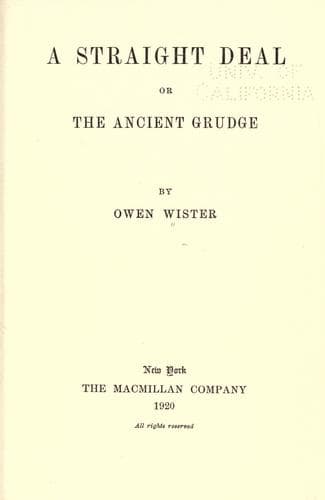
A Straight Deal; Or, The Ancient GrudgeWister, Owen
History
A Straight Deal; Or, The Ancient Grudge
Wister, Owen
Great Britain -- Relations -- United States; United States -- Relations -- Great Britain
The hostess kept it up. Did the American know the Butteredbuns? No?
Well, one met the Butteredbuns everywhere too. They were rather more
extraordinary than the van Squibbers. And then there were the Cakewalks,
and the Smith-Trapezes’ Mrs. Smith-Trapeze wasn’t as extraordinary as
her daughter--the one that put the live frog in Lord Meldon’s soup--and
of course neither of them were “talked about” in the same way that
the eldest Cakewalk girl was talked about. Everybody went to them, of
course, because one really never knew what one might miss if one didn’t
go. At length the American said:
“You must correct me if I am wrong in an impression I have received.
Vulgar Americans seem to me to get on very well in London.”
The hostess paused for a moment, and then she said:
“That is perfectly true.”
This acknowledgment was complete, and perfectly friendly, and after that
all went better than it had gone before.
The half anecdote is a part of this one, and happened a few weeks later
at table--dinner this time.
Sitting next to the same American was an English lady whose conversation
led him to repeat to her what he had said to his hostess at lunch:
“Vulgar Americans seem to get on very well in London society.”
“They do,” said the lady, “and I will tell you why. We English--I mean
that set of English--are blase. We see each other too much, we are
all alike in our ways, and we are awfully tired of it. Therefore it
refreshes us and amuses us to see something new and different.”
“Then,” said the American, “you accept these hideous people’s
invitations, and go to their houses, and eat their food, and drink their
champagne, and it’s just like going to see the monkeys at the Zoo?”
“It is,” returned the lady.
“But,” the American asked, “isn’t that awfully low down of you?” (He
smiled as he said it.)
Immediately the English lady assented; and grew more cordial. When
next day the party came to break up, she contrived in the manner of
her farewell to make the American understand that because of their
conversation she bore him not ill will but good will.
Once more, the scene of my anecdote is at table, a long table in a club,
where men came to lunch. All were Englishmen, except a single stranger.
He was an American, who through the kindness of one beloved member of
that club, no longer living now, had received a card to the club. The
American, upon sitting down alone in this company, felt what I suppose
that many of us feel in like circumstances: he wished there were
somebody there who knew him and could nod to him. Nevertheless, he was
spoken to, asked questions about various of his fellow countrymen, and
made at home. Presently, however, an elderly member who had been silent
and whom I will designate as being of the Dr. Samuel Johnson type, said:
“You seem to be having trouble in your packing houses over in America?”
We were.
“Very disgraceful, those exposures.”
They were. It was May, 1906.
Public-domain text, read in full here on John Shaqi.
Reviews
Reviews
No reviews yet
Be the first to share your thoughts on this work.
Elsewhere in the archive
Join the Discussion
Join the discussion
Sign in to leave a comment or review.
Sign InorCreate an account