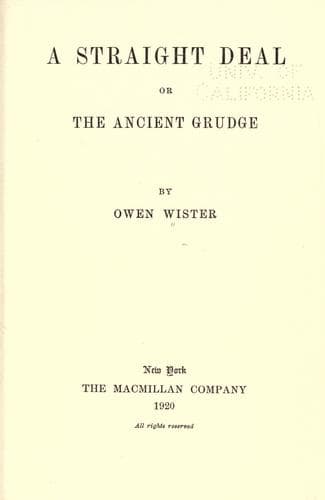
A Straight Deal; Or, The Ancient GrudgeWister, Owen
History
A Straight Deal; Or, The Ancient Grudge
Wister, Owen
Great Britain -- Relations -- United States; United States -- Relations -- Great Britain
In Littell’s Living Age of July 20, 1918, pages 151-160, you may read an
interesting account of British writers on the United States. The bygone
ones were pretty preposterous. They satirized the newness of a new
country. It was like visiting the Esquimaux and complaining that they
grew no pineapples and wore skins. In Littell you will find how few are
the recent Sam Johnsons as compared with the recent friendly writers.
You will also be reminded that our anti-English complex was discerned
generations ago by Washington Irving. He said in his Sketch Book that
writers in this country were “instilling anger and resentment into the
bosom of a youthful nation, to grow with its growth and to strengthen
with its strength.”
And he quotes from the English Quarterly Review, which in that early day
already wrote of America and England:
“There is a sacred bond between us by blood and by language which no
circumstances can break.... Nations are too ready to admit that they
have natural enemies; why should they be less willing to believe that
they have natural friends?”
It is we ourselves to-day, not England, that are pushing friendship
away. It is our politicians, papers, and propagandists who are making
the trouble and the noise. In England the will to friendship rules, has
ruled for a long while. Does the will to hate rule with us? Do we prefer
Germany? Do we prefer the independence of Ireland to the peace of the
world?
Chapter XVI: An International Imposture
A part of the Irish is asking our voice and our gold to help
independence for the whole of the Irish. Independence is not desired
by the whole of the Irish. Irishmen of Ulster have plainly said so.
Everybody knows this. Roman Catholics themselves are not unanimous. Only
some of them desire independence. These, known as Sinn Fein, appeal to
us for deliverance from their conqueror and oppressor; they dwell upon
the oppression of England beneath which Ireland is now crushed. They
refer to England’s brutal and unjustifiable conquest of the Irish nation
seven hundred and forty-eight years ago.
What is the truth, what are the facts?
By his bull “Laudabiliter,” in 1155, Pope Adrian the Fourth invited the
King of England to take charge of Ireland. In 1172 Pope Alexander the
Third confirmed this by several letters, at present preserved in the
Black Book of the Exchequer. Accordingly, Henry the Second went
to Ireland. All the archbishops and bishops of Ireland met him at
Waterford, received him as king and lord of Ireland, vowing loyal
obedience to him and his successors, and acknowledging fealty to them
forever. These prelates were followed by the kings of Cork, Limerick,
Ossory, Meath, and by Reginald of Waterford. Roderick O’Connor, King of
Connaught, joined them in 1175. All these accepted Henry the Second
of England as their Lord and King, swearing to be loyal to him and his
successors forever.
Such was England’s brutal and unjustifiable conquest of Ireland.
Public-domain text, read in full here on John Shaqi.
Reviews
Reviews
No reviews yet
Be the first to share your thoughts on this work.
Elsewhere in the archive
Join the Discussion
Join the discussion
Sign in to leave a comment or review.
Sign InorCreate an account