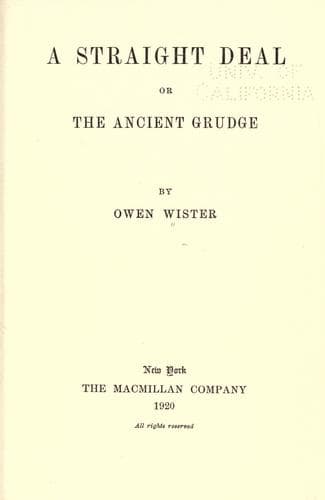
A Straight Deal; Or, The Ancient GrudgeWister, Owen
History
A Straight Deal; Or, The Ancient Grudge
Wister, Owen
Great Britain -- Relations -- United States; United States -- Relations -- Great Britain
The will to friendship--or the will to hate? Which do you choose? Which
do you think is the best foundation for the League of Nations? Do you
imagine that so long as nations do not like each other, that mere words
of good intention, written on mere paper, are going to be enough? Write
down the words by all means, but see to it that behind your words there
shall exist actual good will. Discourage histories for children (and for
grown-ups too) which breed international dislike. Such exist among us
all. There is a recent one, written in England, that needs some changes.
Should an Englishman say to me:
“I have the will to friendship. Is there any particular thing which I
can do to help?” I should answer him:
“Just now, or in any days to come, should you be tempted to remind us
that we did not protest against the martyrdom of Belgium, that we were a
bit slow in coming into the war,--oh, don’t utter that reproach! Go back
to your own past; look, for instance, at your guarantee to Denmark, at
Lord John Russell’s words: ‘Her Majesty could not see with indifference
a military occupation of Holstein’--and then see what England shirked;
and read that scathing sentence spoken to her ambassador in Russia:
‘Then we may dismiss any idea that England will fight on a point of
honor.’ We had made you no such guarantee. We were three thousand miles
away--how far was Denmark?
“And another thing. On August 6, 1919, when Britain’s thanks to her land
and sea forces were moved in both houses of Parliament, the gentleman
who moved them in the House of Lords said something which, as it seems
to me, adds nothing to the tribute he had already paid so eloquently.
He had spoken of the greater incentive to courage which the French and
Belgians had, because their homes and soil were invaded, while England’s
soldiers had suffered no invasion of their island. They had not the
stimulus of the knowledge that the frontier of their country had been
violated, their homes broken up, their families enslaved, or worse. And
then he added: ‘I have sometimes wondered in my own mind, though I have
hardly dared confess the sentiment, whether the gallant troops of our
Allies would have fought with equal spirit and so long a time as they
did, had they been engaged in the Highlands of Scotland or on the
marches of the Welsh border.’ Why express that wonder? Is there not here
an instance of that needless overlooking of the feelings of others, by
which, in times past, you have chilled those others? Look out for that.”
And should an American say to me:
“I have the will to friendship. What can I personally do?” I should say:
Public-domain text, read in full here on John Shaqi.
Reviews
Reviews
No reviews yet
Be the first to share your thoughts on this work.
Elsewhere in the archive
Join the Discussion
Join the discussion
Sign in to leave a comment or review.
Sign InorCreate an account