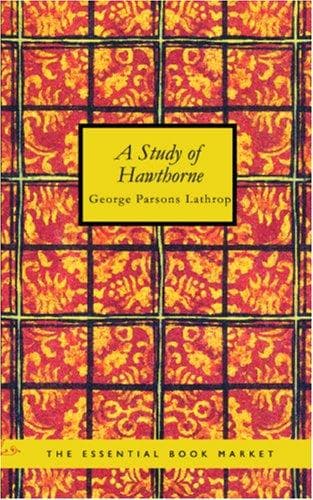
Hawthorne, Nathaniel, 1804-1864; Novelists, American -- 19th century -- Biography
Considered as a work of art, "The Scarlet Letter" is perhaps not so
excellent as the author's subsequent books. It may not unjustly
be called a novel without a plot, so far as this touches the
adroit succession of incidents and the interdependence of parts, which
we call "plot." Passion and motive and character, having been brought
together in given relations, begin to work toward a logical issue; but
the individual chapters stand before us rather as isolated pictures,
with intervals between, than as the closely conjoined links of a drama
gathering momentum as it grows. There is succession and acceleration,
indeed, in the movement of the story, but this is not quite so evident
as is the hand which checks each portion and holds it perfectly still,
long enough to describe it completely. The author does not, like a
playwright, reflect the action swiftly while it passes, but rather
arrests it and studies it, then lets it go by. It may be that this is
simply the distinction between the dramatist's and the novelist's
method; but probably we must allow it to be something more than that,
and must attribute it to the peculiar leisure which qualifies all
Hawthorne's fictions, at times enhancing their effect, but also
protracting the impression a little too much, at times. Yet the general
conception, and the mode of drawing out the story and of illustrating
the characters, is dramatic in a high degree. The author's exegesis of
the moods of his persons is brief, suggestive, restrained; and,
notwithstanding the weight of moral meaning which the whole work
carries, it is impossible to determine how much the movement of events
is affected by his own will, or by that imperious perception of the
necessary outcome of certain passions and temperaments, which influences
novelists of the higher order.
As a demonstration of power, it seems to me that this first extended
romance was not outdone by its successors; yet there is a harshness in
its tone, a want of mitigation, which causes it to strike crudely on the
aesthetic sense by comparison with those mellower productions. This was
no doubt fortunate for its immediate success. Hawthorne's faith in pure
beauty was so absolute as to erect at first a barrier between himself
and the less devout reading public. If in his earlier tales he had not
so transfused tragedy with the suave repleteness of his sense of beauty,
he might have snatched a speedier popular recognition. It is curious to
speculate what might have been the result, had he written "The House of
the Seven Gables" before "The Scarlet Letter." Deep as is the tragic
element in the former, it seems quite likely that its greater gentleness
of incident and happier tone would have kept the world from discovering
the writer's real measure, for a while longer. But "The Scarlet Letter"
burst with such force close to its ears, that the indolent public awoke
in good earnest, and never forgot, though it speedily forgave the shock.
Public-domain text, read in full here on John Shaqi.
Reviews
Reviews
No reviews yet
Be the first to share your thoughts on this work.
Elsewhere in the archive
Join the Discussion
Join the discussion
Sign in to leave a comment or review.
Sign InorCreate an account