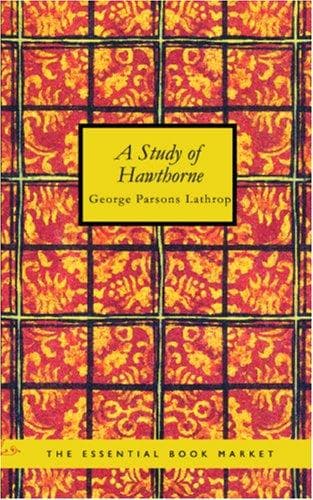
Hawthorne, Nathaniel, 1804-1864; Novelists, American -- 19th century -- Biography
illustrating how he may choose the good or the evil. Donatello is the
ideal of the childlike nature on the threshold of history who has lived
without choosing either, up to the time when his love and defence of
Miriam involve him in crime. Father Antonio, "the spectre of the
catacombs," and Miriam's persecutor, is the outcome of a continual
choice of evil and of utter degradation. These two extremes, more widely
asunder than Prospero and Caliban, Hawthorne has linked together in his
immense grasp of the inmost laws of life, and with a miraculous nicety
of artistic skill. Then comes Donatello's fall, illustrating the genesis
of sin from crime, in accordance with the Biblical story of Cain; and
this precipitates an examination, not only of the result upon Donatello
himself, but of the degree in which others, even the most guiltless, are
involved. There is first the reaction upon and inculpation of Miriam,
whose glance had confirmed Donatello's murderous intent; only a glance,
yet enough to involve her in the doom of change and separation--of sin
in short--which falls upon the Faun. And in Hilda's case, it is the
simple consciousness of another's guilt, which is "almost the same as if
she had participated" in it. The mutual relations of these persons, who
are made to represent the whole of society, afford matter for infinite
meditation, the artistic and moral abstract of which the author has
given.
But with this main theme is joined a very marvellous and intricate study
of the psychology of Beatrice Cenci's story, in a new form. Miriam is a
different woman placed in the same circumstances which made the Cenci
tragedy. In the "French and Italian Note-Books," Hawthorne describes the
look he caught sight of in Guido's picture,--that "of a being
unhumanized by some terrible fate, and gazing out of a remote and
inaccessible region, where she was frightened to be alone, but where no
human sympathy could reach her." It was of this single insight that both
Miriam and Hilda were born to his mind. He reproduces this description,
slightly modified, in the romance (Vol. I. Chap. XXIII.): "It was the
intimate consciousness of her father's guilt that threw its shadow over
her, and frightened her into" this region. Now, in the chapter called
"Beatrice," quite early in the story, he brings out between Miriam and
Hilda a discussion of Beatrice and her history. It is evident, from the
emphasis given by the chapter-title, that this subject is very deeply
related to the theme of the romance; and no theory can explain Miriam's
passionate utterances about the copy of Guido's portrait, except that
which supposes her own situation to be that of Beatrice. This chapter is
full of the strongest hints of the fact. Miriam's sudden resemblance to
the picture, at the instant when she so yearns to grasp the secret of
Beatrice's view of her own guilt or innocence; her ardent defence of
Beatrice's course, as "the best virtue possible under the
Public-domain text, read in full here on John Shaqi.
Reviews
Reviews
No reviews yet
Be the first to share your thoughts on this work.
Elsewhere in the archive
Join the Discussion
Join the discussion
Sign in to leave a comment or review.
Sign InorCreate an account