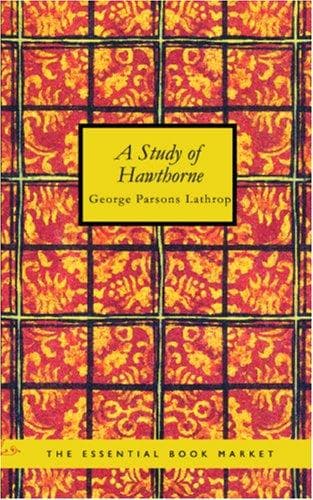
Hawthorne, Nathaniel, 1804-1864; Novelists, American -- 19th century -- Biography
But there is a suitable difference between the working of the womanly
element in "Faust" and in Hawthorne's romance. In the former instance it
is through the gratification of his infernal desire that the hero is
awakened from his trance of error and restored to remorse; while
Septimius's failure to accomplish his intended destiny appears to be
owing to the inability of his aspiring nature to accommodate itself to
that code of "moral dietetics" which is to assist his strange project.
"Kiss no woman if her lips be red; look not upon her if she be very
fair," is the maxim taught him. "If thou love her, all is over, and thy
whole past and remaining labor and pains will be in vain." How pathetic
a situation this, how much more terrible than that of Faust, when he has
reached the turning-point in his career! A nature which could accept an
earthly immortality on these terms, for the sake of his fellows, must
indeed have been a hard and chilly one. But there is still too much of
the heart in it, to admit of being satisfied with so cruel an
abstraction. On the verge of success, as he supposes, with the
long-sought drink standing ready for his lips, Septimius nevertheless
seeks a companion. Half unawares, he has fallen in love with Sybil, and
thenceforth, though in a way he had not anticipated, "all is over." Yet,
saved from death by the poison in which he had hoped to find the spring
of endless life, his fate appears admirably fitting. There is no picture
of Mephisto hurrying him off to an apparently irrevocable doom. The
wrongs he has committed against himself, his friends, humanity,--these,
indeed, remain, and are remembered. He has undoubtedly fallen from his
first purity and earnestness, and must hereafter be content to live a
life of mere conventional comfort, full of mere conventional goodness,
conventional charities, in that substantial English home of his. Could
anything be more perfectly compensatory?
Nothing is more noticeable than the way in which, while so many
symbolisms spring up out of the story, the hero's half-crazed and
bewildered atmosphere is the one which we really accept, until the
reading is ended. By this means we are enabled to live through the whole
immortal future which he projects for himself, though he never in
reality achieves any of it. This forcing of the infinite into the
finite, we are again indebted to Mr. Higginson for emphasizing as "one
of the very greatest triumphs in all literature." "A hundred separate
tragedies," he says, "would be easier to depict than this which combines
so many in one."
Public-domain text, read in full here on John Shaqi.
Reviews
Reviews
No reviews yet
Be the first to share your thoughts on this work.
Elsewhere in the archive
Join the Discussion
Join the discussion
Sign in to leave a comment or review.
Sign InorCreate an account