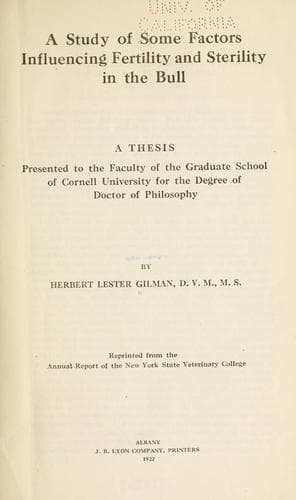
A study of some factors influencing fertility and sterility in the bullGilman, Herbert Lester
Science
A study of some factors influencing fertility and sterility in the bull
Gilman, Herbert Lester
Cattle; Infertility in animals; Livestock; Thesis (Ph. D.)
that there is a correlation of function between these (endocrine) glands
and that some cases of sterility are probably due to a derangement of
this correlation.” Biedl (45) concludes: “There appears to be an
intimate anatomical and physiological interrelationship between the
different blood glands which is manifested clinically by the fact that
the pathological disturbance of one gland is accompanied by symptoms
pointing to the functional derangement of one or more of the others.
Knowing, as we do, the many sided interactivity which subsists between
the different internal secretory organs, it is readily conceivable that
isolated diseases of single organs of this group are very much rarer
than, at the first glance, they would appear to be. In the present state
of our knowledge, the only course of investigation which is open to us
is to start with the known results of the functional derangement of any
organ, and, by following these up, to seek the primary link in the
pathological chain.”
Most workers seem to agree that a special connection exists between the
normal function of the adrenal cortex and the sexual organs. Tumors of
the former are usually associated with sex abnormalities, and feeding
young animals the gland substance seems to stimulate growth of the
testes.
Many arguments have been brought forward to show that the prostate
produces an internal secretion. It is a well known fact that this organ
atrophies after castration, and enlarges as the sex life dwindles. As
has been previously stated, Serrlach and Pares reached the conclusion
that the gland produces an internal secretion which controls the
testicular functions and regulates the process of ejaculation. Also they
state that if the prostate is removed, spermatozoa are no longer
produced in the testes, and that the secretory activity of the accessory
genital gland ceases. The secretion is, at any rate, a stimulus to the
internal secretion of the testis.
The thyroid bears a distinct biological relationship to the sexual
glands. Removal of the gland results in imperfect development of the
gonads, infantilism, and general torpor. Bell (42) believes that the
association between the thyroid gland and the genitalia is as intimate
as the relation of the pituitary to the genital functions.
Of all the endocrines, perhaps the anterior lobe of the hypophysis is in
most intimate correlation with reproduction. Castration results in
hypertrophy of this organ, while removal of the anterior lobe usually
leads to death. In those cases in which death does not ensue, it results
in genital atrophy, stunting, and reduction of sexual activity. In young
animals, spermatogenesis ceases entirely even after partial extirpation
of the anterior lobe. Biedl (45) states that “in disease of the
hypophysis, derangement of sexual activity occurs very early in the
course of the disease, shown in women by the cessation of menstruation,
and in men by impotence.”
Public-domain text, read in full here on John Shaqi.
Reviews
Reviews
No reviews yet
Be the first to share your thoughts on this work.
Join the Discussion
Join the discussion
Sign in to leave a comment or review.
Sign InorCreate an account