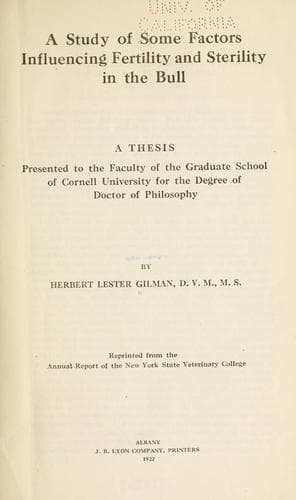
A study of some factors influencing fertility and sterility in the bullGilman, Herbert Lester
Science
A study of some factors influencing fertility and sterility in the bull
Gilman, Herbert Lester
Cattle; Infertility in animals; Livestock; Thesis (Ph. D.)
The thymus, as is well known, is quite intimately associated with the
development of the genital organs. Its normal disappearance is always
associated with the development of sexual maturity in the individual.
Hewer (46) conducted experiments to ascertain the effect of thymus
feeding on the activity of the reproductive organs in the rat. She
concludes in part: “Male rats appear more susceptible to the influence
of thymus feeding than female rats. With moderate doses of thymus,
sexual maturity in the animals treated is delayed, a phenomenon which is
attributed to delayed development of the testis. With large doses of
thymus, in the male, the testis is structurally affected: in the young
animal in the direction of retardation of development, in the mature
animal in the direction of degeneration. This degeneration is confined
to the testes. In the degenerating testis, cells of Sertoli appear to be
absent: the spermatogonia are present, also dividing, and may lie free
in the lumen of the tubule; spermatids, many with abnormal nuclei, are
shed into the lumen in large numbers; spermatozoa are practically
absent. In the later stages, only a few dividing spermatogonia appear
among the debris of the other unrecognizable cells of the tubule. In the
epididymis which itself is normal, when the testis is showing
degeneration, very few spermatozoa appear, in the later stages none.
Many spermatids are present in various stages, and some spermatocytes.
Animals in the hyper-thymic condition appear to be sterile.”
The foregoing references will, I hope, serve to bring out the facts that
environment and diet, together with the general body metabolism and the
endocrines, have a more or less profound effect upon the development,
growth, and functioning of the genital system. In the experiments it has
been shown that sterility is not necessarily accompanied by any apparent
microscopical changes in the gonads, or even at times in the general
body health. Nor can we exclude impotency of the male entirely even when
the spermatozoa are normal in shape, and motility. Carnett, and others
(38), years ago stated: “Indeed, there is abundant clinical proof to the
effect that systemic conditions which have no appreciable effect upon
the motility or conformation of the spermatozoa materially interfere
with reproductive power.” The entire complex genital system is
inseparably linked up with the body as a whole, a fact which we must
bear in mind at all times.
Public-domain text, read in full here on John Shaqi.
Reviews
Reviews
No reviews yet
Be the first to share your thoughts on this work.
Join the Discussion
Join the discussion
Sign in to leave a comment or review.
Sign InorCreate an account