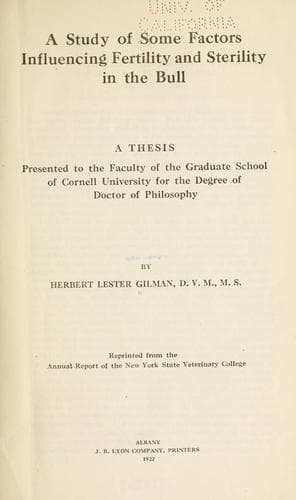
A study of some factors influencing fertility and sterility in the bullGilman, Herbert Lester
Science
A study of some factors influencing fertility and sterility in the bull
Gilman, Herbert Lester
Cattle; Infertility in animals; Livestock; Thesis (Ph. D.)
_Infection_ is without doubt the greatest single factor capable of
producing functional and anatomic changes resulting in varying degrees
of impotency and sterility. The changes produced range from the addition
of the toxic products of bacterial growth to the seminal fluid, to the
complete destruction of the parenchymatous tissue of one or more of the
contributing sexual glands. Anatomic changes are by no means essential
to the production of lowered fertility. As has been previously stated,
the work on veal calves indicates that the genital organs of young bulls
are normally free from bacteria. Likewise in normal adult animals, the
bacterial content of the genital organs is as a rule low or negative. It
is possible that a certain flora is normal for the tract at sexual
maturity, as in several other organs of the body, but under the strain
of sexual excess, defective diet, or other weakening influences, these
organisms may become pathogenic. Streptococci and staphylococci have at
times been found in apparently normal parts of the body, and at other
times they are found associated with severe pathological lesions in the
genital tract. The degree of pathogenicity is of course difficult to
determine, except as we find the bacteria associated with abnormal
conditions. Carpenter (9), however, injected streptococci into the
genital tracts of female calves and produced lesions resembling very
closely those from which the organisms had been isolated in adult
sterile animals. Personally, I am inclined to believe that the genital
organs normally are free from bacteria, or if any are there they are
better able to multiply under the strain of devitalization of the
tissues. Bacterial invasion, however, does take place quite frequently,
but the paths of entrance of the organisms are somewhat problematical.
Hematogenous origin is always possible, though it is rather difficult to
definitely implicate this mode of entrance. The urethra is perhaps the
easiest and most common path for the entrance of bacteria, though even
here it is not possible to make definite assertions. Contiguous spread
of infection from neighboring structures is very probable in some cases,
particularly in pelvic peritonitis. The bacteriological results hardly
bear out the theory of Williams that the organisms lie dormant in the
genitalia of the animals until the advent of sexual maturity, at which
time they acquire pathogenic powers. On the other hand, his clinical
observations seem to indicate that this may be possible. Calves
suffering from “calf infections” frequently do harbor organisms in their
genital organs, but whether or not they persist there till sexual
maturity is a matter of conjecture. The most logical theory seems to be
that animals from herds in which genital infections are very severe, or
those that have had severe attacks of scours or pneumonia, are more
susceptible to those infections, due to the early lowering of their
vitality.
Public-domain text, read in full here on John Shaqi.
Reviews
Reviews
No reviews yet
Be the first to share your thoughts on this work.
Join the Discussion
Join the discussion
Sign in to leave a comment or review.
Sign InorCreate an account