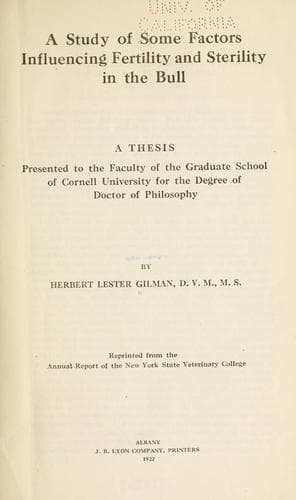
A study of some factors influencing fertility and sterility in the bullGilman, Herbert Lester
Science
A study of some factors influencing fertility and sterility in the bull
Gilman, Herbert Lester
Cattle; Infertility in animals; Livestock; Thesis (Ph. D.)
_Impediments to coitus_ may be due to great difference in the size of
the two mated individuals, psychic disturbances, or inability to
protrude the penis. Williams (17) mentions several physical impediments,
as deformity of the limbs or feet, sore feet, overloading of the rumen,
obesity, fear of falling, and paralysis. Coitus may be somewhat delayed,
or even not performed as the result of a severe inflammation with
sensitiveness of the penis or prepuce. Occasionally tumors of the penis
are encountered which may interfere with protrusion of the penis, or its
entrance into the vagina. Not infrequently the penis is rendered
incapable of protrusion as the result of inflammatory adhesions,
tuberculosis of the preputial lymph glands, etc.
_Excessive sexual use_, within certain limits, probably has not, in
itself, any material permanent effect upon the reproductive capacity.
The frequency with which bulls used to excess break down sexually, is
probably due to the devitalizing effect upon the tissues of the genital
organs, this opening the way to bacterial invasion and other destructive
influences. Over-use is probably not dangerous, unless continued over
long periods, but at the same time it offers greater opportunity for
infection to be introduced into the body from intercourse with large
numbers of females. Lloyd-Jones and Hays (47) carried on very
interesting experiments on the influence of excessive sexual activity of
male rabbits on the properties of the semen. Their plan was to mate male
rabbits in quick succession, and study the character of the semen on the
first service, and every fifth service thereafter. The safe limit was
twenty services in three hours. As would be expected, the volume of the
semen, after the first few services, became gradually reduced in amount.
“In rapidly successive services, the semen becomes less viscous and
tends to lose its characteristic milky appearance until at the twentieth
service, when the fluid is thin and watery.” It seemed as though there
was a well marked reduction in the number of spermatozoa per cubic
centimeter in the advanced services. Successive copulations also
resulted in a marked decrease in the number of motile spermatozoa,
together with a shorter duration of perceptible vitality. The certainty
of producing impregnation at the same time became less and less. “This
reduction in the per cent of effective matings when the male is sexually
overworked is recognized by those engaged in animal breeding as one of
the most noticeable and universal concomitants of heavy sexual service.”
In another paper, these same authors studied the effect of sexual excess
upon the character of the offspring. In part, they conclude: “By no
means thus far used has any inferiority of progeny from the heavy sexual
service been discovered. They are fully equal if not superior to progeny
from very light service of male.”
Public-domain text, read in full here on John Shaqi.
Reviews
Reviews
No reviews yet
Be the first to share your thoughts on this work.
Join the Discussion
Join the discussion
Sign in to leave a comment or review.
Sign InorCreate an account