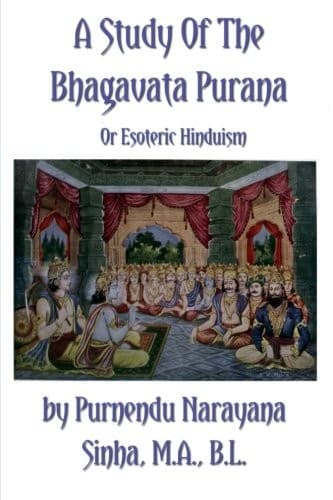
A Study of the Bhâgavata Purâna; or, Esoteric Hinduism
Religion
A Study of the Bhâgavata Purâna; or, Esoteric Hinduism
Puranas. Bhagavatapurana. English
THE STORY OF AJÂMILA
*SKANDHA VI. CHAP. 1-3.*
Râjâ Parikshit asked how men could avoid Naraka.
SUKA replied: — It is by Prâyaschitta (expiation) that men can avoid
Naraka. But it is not Vedic Prâyaschitta, not fasting by Chândrâyana and
other Vratas. These Vedic performances cannot root out vicious
tendencies, for the performer is seen again to indulge in vices. They do
not purify the mind. They simply counteract the Kârmic effect of the act
for which Prâyaschitta is performed. The real Prâyaschitta is devotion
to Vishnu.
Ajâmila was the son of a Brâhmana. He was dutiful, virtuous, modest,
truthful, and regular in the performance of Vedic injunctions. One day
in obedience to his father he went into the forests and there collected
fruits, flowers, sacrificial wood and _Kusa_ — on returning he saw a
Sudra in company with a slave-girl. He tried much to subdue his passions
but did not succeed. He spent the whole of his patrimony to win the love
of that girl. He gave up his own wife and kept company with that slave
girl. He had by her several sons of whom the youngest was Nârâyana.
Ajâmila lost all his good qualities in low company and he forgot his
daily practices. To support the woman and her children, he had recourse
to all sorts of vicious and unlawful acts. Nârâyana was the favorite
among his sons. He caressed him always. At last his end approached. He
thought even then of his youngest son who was playing at a distance.
Three fierce-looking messengers of Yâma appeared, with ropes in hand.
Terrified at the sight Ajâmila cried out "Nârâyana, Nârâyana." Instantly
the Messengers of Vishnu appeared. At the time when the servants of Yâma
were drawing out the Jiva from the heart of Ajâmila, the attendants of
Vishnu stopped them with a strong voice. "But who are you" said they "to
interfere with the just sway of Yâma." The bright attendants of Vishnu
only smiled and asked: "What is Dharma? Does your lord Yâma hold the
sceptre of punishment against all who perform Karma? Is there no
distinction made?"
The astral messengers replied: — "The performance of Vedic Injunctions
is Dharma and their disregard is Adharma. This Ajâmila in his earlier
days duly respected the Vedas. But in company with the slave-girl, he
lost his Brahmânism, disregarded the Vedas and did things which a
Brâhmana should not do. He justly comes for punishment to Yama."
The attendants of Vishnu expressed wonder at these words. "And you are
servants of him, who is called the king of Dharma, and you do not know
that there is something above the Vedas too. This Ajâmila consciously or
unconsciously took the name of Nârâyana and that saved him from your
clutches. It is in the nature of fire to consume fuel and so it is in
the nature of Vishnu’s name to destroy all sins. If one unconsciously
takes some powerful medicine, does it not have effect? It matters not
whether Ajâmila meant his youngest son or not but still he took the name
of Nârâyana. So you must retire."
Public-domain text, read in full here on John Shaqi.
Reviews
Reviews
No reviews yet
Be the first to share your thoughts on this work.
Elsewhere in the archive
Join the Discussion
Join the discussion
Sign in to leave a comment or review.
Sign InorCreate an account