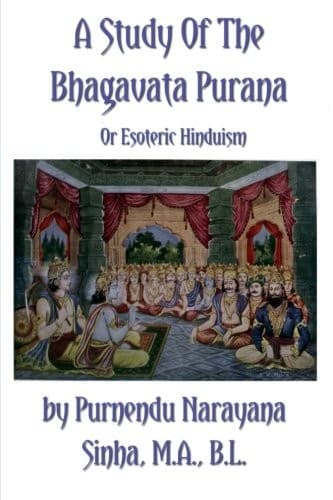
A Study of the Bhâgavata Purâna; or, Esoteric Hinduism
Religion
A Study of the Bhâgavata Purâna; or, Esoteric Hinduism
Puranas. Bhagavatapurana. English
The Daityas are opposed to the Â-dityas. The root verb _dâ_ means to cut
to pieces, to separate. _Diti_ is that which separates. _Aditi_ is that
which does not separate. Jivâtmâ is the same in all beings. One life
principle animates all the forms of creation. The idea of separateness
did not exist from before. The elementals that began life in this Kalpa
from the spiritual plane, have hardly any idea of separate existence.
The Devas and Pitris are described as classes (_ganas_), and not as
individuals. In the Mineral Kingdom, again, there is no individual
existence. Individuality has to be worked out, and the sons of Diti
bring about this great work in the evolution of life forms.
When we have the sense of separate existence strong in us, we become
capable of further evolution. By our individual experiences, we know
what is right and what is wrong, what is pleasurable and what is
painful. Things that give joy give pain as well. It is the measure of
pleasure or pain that teaches us what to covet and what to shun. Then we
have the fact that by our very existence we have duties to perform. The
teachings of other ages that are revealed to the Rishis and proclaimed
by them, give us a better idea of things, and they tell us more than we
can know of by our own experience. The Asuras lead us on and on, till we
reach the highest point that, with a sense of individuality, we may
attain.
When the individual soul gathers all experience that may be acquired by
the idea of separateness, it traces back its way to that spiritual home
whence it came. In the return journey, it is helped by the Âdityas, who
gradually efface the idea of separateness, by an ever increasing
infusion of Satva: Vishnu himself became Âditya and taught men the unity
of all souls.
The Âdityas who guided the early elementals had to be crushed, so that
separateness might grow. Pushan and Bhaga were therefore overpowered by
the attendants of Śiva at the sacrifice of Daksha.
The Âdityas who guide humanity in their return to spirituality are
themselves high spiritual energies, the highest Devas of our Trilokî.
Our evolution is thus two-fold — individual and non-individual. When we
work as individuals, we are under the influence of Daityas. When we want
to cast off separateness, we are under the influence of the Âdityas.
In both cases, however, it is the bliss element in us that is worked on
by the Daityas and A-dityas. This bliss element is our eternal heritage
from Ishvara, and it is this element that saves us in our contact with
manifold matter. The measure of bliss, (_ananda_), enables us to judge
what matter to accept and what not.
Individuality developed under Hiranyakasipu, and all sorts of blissful
experiences were acquired. The sons of Hiranyakasipu were all called
Bliss (Hrâda), but the perfection of Bliss (Pra-Hrâda) was in Prahlâda,
He found out that the worldly joys were unreal, and that the real joy
could be had only from Him above, who was joy itself.
Public-domain text, read in full here on John Shaqi.
Reviews
Reviews
No reviews yet
Be the first to share your thoughts on this work.
Elsewhere in the archive
Join the Discussion
Join the discussion
Sign in to leave a comment or review.
Sign InorCreate an account