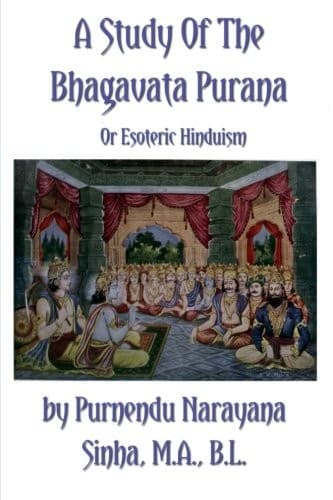
A Study of the Bhâgavata Purâna; or, Esoteric Hinduism
Religion
A Study of the Bhâgavata Purâna; or, Esoteric Hinduism
Puranas. Bhagavatapurana. English
The Asuras advanced as the Kâlpic age advanced. There was no end of
advancement from the standpoint of self. There is no big jump from
individual self to universal self. Though the essential idea of
spirituality is unity and the essential idea of materiality is
diversity, the one idea develops into the other idea, by an ever
widening view of things. Our duties enlarge. Our relations increase. The
range of life widens, till it includes the life in Svarga. Vedic Yajna
is then performed, though from a pure motive of self-advancement. The
advanced self comes very near to the universal self. The performance of
Vedic sacrifices is Asuric in so far as it is selfish, but it minimises
the self of earthly existence, and gives a transitory character to our
worldly joys and sufferings, and it gives the idea of an enlarged self,
of widened existence and of higher duties. The Karma Kânda of the Vedas
therefore opens the door widely to real spiritual life.
This explains why Vishvarupa, an Asura, guided the Devas for some time.
The three heads of Vishvarupa represent the three Vedas. The swallow
head is the Rik, the sparrow head is the Sâman, and the Tittiri head is
proverbially the Yajur. This refers to the prevalence of Karma Kânda.
But when better times came, Indra killed Vishva-rûpa. The place of
Vishva-rûpa was however speedily taken, up by Vritra. And Indra had
recourse to Atharva, the fourth Veda and to Dadhîchi, a votary
(represented as the son) of Atharva Veda, the very ideal of
self-sacrifice.
And who is this Vritra? The Vedas say: — _"Sa imân lokân Avrinot etat
Vritrasya Vritratvam."_
He spread over (_vri_) all these Lokas, this is the Vritraship of
Vritra.
The Bhâgavata says: — "These Lokas are spread over by him in the form of
Tvashtri’s Tapas. Hence he is called Vritra." VI. — 9-xviii.
The invocation of Tvashtri is thus described in the Bhâgavata: — "Rise
up, O Indra — Shatru, never give up enmity." VI — 9-xii.
The word _shatru_ means enemy. Tvastri meant to say "he who is to become
the enemy of Indra." But by proper grammatical construction, the
expression means, he of whom Indra is to become the enemy. The
invocation was therefore defective and it produced a contrary result.
Pânini points this out as an apt illustration of what bad grammar leads
to.
The Vedas thus speak of the invocation: — "As he said-_Svâha_! O
Indra-Shatru! rise up — so Indra became the enemy of Vritra."
Notwithstanding his wisdom, Chitra-ketu was anxious to have a son. He
wept bitterly, when the son was lost. He was a votary of Sankarshana,
who presides over Ahankâra or Egoism. So by devotion he became the king
of the Vidyâdharas. This selfish devotion, the worship of Gods for the
gratification of selfish aspiration, which is so universal, is Vritra.
Public-domain text, read in full here on John Shaqi.
Reviews
Reviews
No reviews yet
Be the first to share your thoughts on this work.
Elsewhere in the archive
Join the Discussion
Join the discussion
Sign in to leave a comment or review.
Sign InorCreate an account