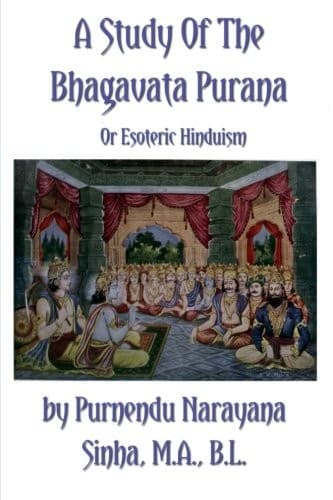
A Study of the Bhâgavata Purâna; or, Esoteric Hinduism
Religion
A Study of the Bhâgavata Purâna; or, Esoteric Hinduism
Puranas. Bhagavatapurana. English
The Serpent King Vasûki was assured of a share in Amrita and he
consented to become the rope. The Mountain was then surrounded by
Vasûki. Vishnu followed by the Devas held the mouth of the serpent. But
the Asuras said: — "We have learned the Vedas, we know the Sâstras, it
is improper for us to hold the tail of a serpent. We will not do that.
It is inauspicious." Vishnu smiled. He and the Devas gave up the mouth
end and held the tail.
The churning then commenced. The Mountain was however heavy and it sank
down to the bottom of the ocean. The Devas and Asuras became mournful.
Vishnu then assumed the form of a Tortoise, went into the water and
raised the Mountain. He then remained like a Dvipa one lakhsa Yojanas in
expanse with the mountain on his back. He infused his influence all
round. Energised by Him, the Devas and Asuras vigorously carried on the
churning. At last fire and smoke came out from the thousand mouths of
Vasûki. This overpowered the Asuras and the Devas — but the Devas were
refreshed by clouds, rains, and winds sent by Vishnu.
After a good deal of churning, poison came out first. It spread out on
all sides and the Prajâpatis and their progeny in terror took the
shelter of Śiva. Śiva felt compassion for them and with the approval of
Durgâ, he drank up the whole of the poison. It made his throat blue.
The Churning recommenced. Out came Surabhi (the fabulous cow of plenty).
The Vedic Rishis took that Cow for the necessaries of Yajna. Then came
the horse Uchchaih-Sravas. Bali desired to have it. But Indra as
directed by Vishnu made no desire. Then came the elephant Airavata, then
the 8 space elephants and their 8 female partners.
Next arose Kaustubha, the celebrated lotus-colored gem. Vishnu wished to
have it as an ornament for His breast. Next came Pârijâta, then the
Apsaras.
Illumining all sides with her lustre arose Lakshmî. All paid homage to
her. She looked on all sides, but found none, whom she could accept. If
there was an ascetic he could not control his anger. If there was a
Jnâni (sophist) he could not get over attachments. There might be a
Mahâtmâ, but he had not conquered his passion of love. How could he be
called Îsvara, who depended on others, (and no one but Îsvara could
claim Lakshmî). If there was Dharma any where, there was not
friendliness for all beings. If there was sacrifice, it was not for
liberation. There was power but it could not resist the flow of time. If
there was one void of likes and dislikes, he did not take a companion.
If there was any one long lived, he had neither good nature (_Sila_) nor
auspiciousness (_Mangala._) If one had good nature and auspiciousness,
he was not long lived. If one had all the Virtues he was out of his
element with her. If he was all that she wanted he did not want her.
Public-domain text, read in full here on John Shaqi.
Reviews
Reviews
No reviews yet
Be the first to share your thoughts on this work.
Elsewhere in the archive
Join the Discussion
Join the discussion
Sign in to leave a comment or review.
Sign InorCreate an account