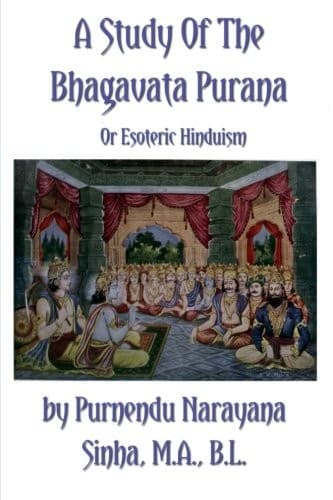
A Study of the Bhâgavata Purâna; or, Esoteric Hinduism
Religion
A Study of the Bhâgavata Purâna; or, Esoteric Hinduism
Puranas. Bhagavatapurana. English
Urvasi came after a year, with one son. She advised the king to entreat
the Gandharvas for her hands. The king did so and the Gandharvas became
pleased with him. They gave him one Agnisthâli (pot of fire). The king
took the Agnisthâli to be Urvasi and roamed with it in the forest. (The
Gandharvas gave him the fire for the performance of sacrifice necessary
for the attainment of Urvasi). The king found out his mistake at last.
He then placed the fire in the forest, went home and meditated every
night on Urvasi. On the approach of Tretâ, he was inspired with the
three Vedas (Karma-Kânda). He then went to the place of fire and found
there one Asvatha tree (the sacred fig) grown from inside a Śami tree
(Śami is the name of a tree said to contain fire). He decided that the
fire must be within the Asvatha tree. He took two pieces of wood
(technically called Arani) from that tree and produced fire by their
friction. He deemed one piece to be Urvasi and another piece to be
himself and the space between the two pieces to be his son. By friction,
the fire called Jatavedas came out. (_Vedas_ is wealth, enjoyments in
general. _Jâta_ is grown. Jata-vedas is that fire from which enjoyments
proceed that which gratifies all sense-desires. It is the chief fire of
the Karma-kânda of the Vedas). By the invocation of the three vedas,
that fire became three fold. (Âhavaniya, Gârhapatya, and Dakshinâ are
the three fires perpetually kept in the household. _Âhavaniya_ is the
eastern fire which represents the relations of the house holder with the
Devas. _Gârhapatya_ is the sacred fire which the householder receives
from his father and transmits to his descendants and from which fires
for sacrificial purposes are lighted. It represents household and family
duties. _Dakhina_ is the southern fire. It represents all classes of
duty to the Pitris). The king imagined this threefold fire to be his son
(The son by his offerings sends his father’s soul to Svarga. The
sacrificial fire also sends the performer to Svarga). With that fire, he
performed Yajna desiring to reach the Loka (plane) of Urvasi. Prior to
this in Satya Yuga, Pranava was the only Veda, Nârâyana was the only
Deva, there was only one fire and only one caste. The three Vedas came
only from Pururavas, at the beginning of Treta Yuga. The king attained
Gandharva Loka by means of the fire. (In Satya Yuga, Satva generally
prevailed in men. Therefore they were all fixed in meditation. But in
Treta Yuga, Rajas prevailed and by the division of the Vedas, Karma
Mârga made its appearance. _Śridhara_.)
Public-domain text, read in full here on John Shaqi.
Reviews
Reviews
No reviews yet
Be the first to share your thoughts on this work.
Elsewhere in the archive
Join the Discussion
Join the discussion
Sign in to leave a comment or review.
Sign InorCreate an account