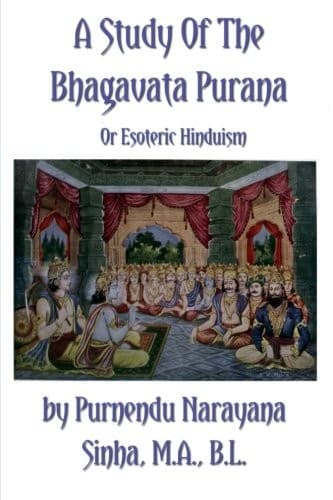
A Study of the Bhâgavata Purâna; or, Esoteric Hinduism
Religion
A Study of the Bhâgavata Purâna; or, Esoteric Hinduism
Puranas. Bhagavatapurana. English
For a time the Râkshasas reigned supreme, but not over the new
continent, permeated as it was by the sacred waters of the Ganges. Their
stronghold was Lankâ, the remnant of the Atlantean continent. Following
the descent of Gangâ therefore, Vishnu incarnated himself as Râma, one
of the greatest of his manifestations. The Râkshasas of Lankâ were
killed. Vibhishana only survived, but he was allied to Râma and so
became immortal in spirituality. The Râkshasa survives in us but its
energy of dissolution does not militate against the evolution of man. It
was Râma who first gave the idea of Íshvara to the degraded human races
of the present Manvantara. They knew, for the first time, that there was
one greater than all the Devas — the Gods of the Vedas — and that there
were planes higher than even Svarga. The path of devotion was
proclaimed. And it became possible for men to cross the limits of death
and of Trilokî by this quality. The downfall was stopped no doubt; but
the ascent was only permanently secured by Lord Sri Krishna as we shall
see later on.
After Râma, there is little of interest in the line of Ikshvâku. The
decline commenced and the line became extinct with Sumitra, but it is
said one king Maru of this line became an adept in Yoga and retired to
Kalapa, where he bides his time to revive the solar dynasty towards the
end of the Kaliyuga. We may take him to be the originator of another
race which will be the re-incarnation of the Ikshvâku race.
We have considered the line of Ikshvâku’s descendants through Purukutsa.
There is another line of his descendants through Nimisha. Then we come
to the Lunar Dynasty.
The Lunar races first appeared while the descendants of Ikshvâku were
still flourishing, though on the eve of their decline. They had immense
possibilities of spiritual evolution, and the great Aryan race seems to
be connected with them. The appearance of these races is almost
simultaneous with the first flow of the Ganges. For we find Jahnu, who
swallowed up the Ganges in her first terrestrial course, is only sixth
in the line of descent from Pururavas.
The Lunar dynasty originated in the union of Târâ, the female principle
of Brihaspati (Jupiter), and the Moon. The issue was Budha (Mercury),
the direct progenitor of the Lunar dynasty.
The son of Budha was Pururavas. He married Urvasi, the renowned Deva
nymph.
Pururavas had six sons. But we are concerned with only two of them, Âyus
and Vijaya.
Vijaya gave the Adept line of the race and Âyus, the ordinary humanity.
In the line of Vijaya, we find Jahnu, purified by the assimilation of
Gangâ, Visvâmitra, pre-eminently the Rishi of the Rig Veda and one of
the seven sages who watch over the destiny of the present Manvantara,
Jamadagni, another of the seven sages of our Manvantara and Parasurâma
one of the coming sages of the next Manvantara. We have already
mentioned the part taken by Visvâmitra and his sons in the composition
of the Vedic Mantras.
Public-domain text, read in full here on John Shaqi.
Reviews
Reviews
No reviews yet
Be the first to share your thoughts on this work.
Elsewhere in the archive
Join the Discussion
Join the discussion
Sign in to leave a comment or review.
Sign InorCreate an account