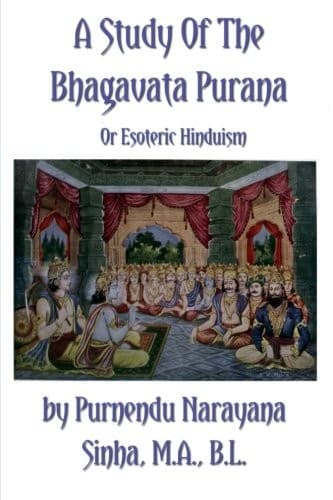
A Study of the Bhâgavata Purâna; or, Esoteric Hinduism
Religion
A Study of the Bhâgavata Purâna; or, Esoteric Hinduism
Puranas. Bhagavatapurana. English
Leaving this general resumè, we may now enter upon a closer study of
the history of religious movements in our present Manvantara, so that we
may understand the great work done by Lord Sri Krishna. The races live
as individuals live. However developed an individual may be, when he is
re-born after death, he first becomes a child as any other child. There
is much of spiritual life in the child, and sometimes pictures of
heavenly life are presented to his spiritual vision, which are denied to
to the grown-up man. The child begins his life when he is grown up, and
then his individual characteristics soon manifest themselves. We do not
read much of the man in the child. Hence the history of the early
spiritual races, who were infants in the racial life, does not teach us
anything. We find some of them had communion with the Devas of Svarga
Loka, but that is more on account of their infant spirituality than any
thing else.
When the races developed in time, they became most intellectual as well
as most material at the same time. Manvantara after Manvantara was taken
up in developing the physiological (Pranic) activities, the sense
(Indriya) activities, and then the lower mental activities of the Jivas.
The personal man was fully developed in the sixth Manvantara and the
great churning only opened the door for another line of development. The
possibility of spiritual activity was secured to men by Kûrma.
When the races of the Sixth Manvantara therefore became reborn in the
Seventh Manvantara, they were the most intellectual of all races, but
they had also the power given to them of developing spiritual faculties.
They could not however shake off the Asuric element all at once. They
were extremely fond of material joys, and they devised all means, which
human intellect could contrive, of gratifying material desires. That was
right which gave material gratification; that was wrong which militated
against material enjoyment.
Bhuvar Loka is the plane of animal desires. The human beasts go after
death to Bhuvar Loka. They do not possess anything which could take them
to Svarga Loka.
The Svarga Loka is for those who develop in themselves the faculty of
discriminating between right and wrong, and who do or attempt to do what
is right. Far more it is for those who love others and who do good to
them. For service and love pertain to planes higher even than Svarga.
But in the higher planes, service is unselfish and love is divine. The
lower forms of service and love pertain to the plane of Svarga. In
Svarga there is selfishness, but it is mixed with spirituality. It is
only the good, the virtuous, the devoted that go to the plane of the
Devas and there gratify their higher desires to their heart’s content.
There are divine music, divine beauty, divine objects of gratification
in Svarga Loka — allurements enough for a man of desire. And if his
merits be great, he enjoys the things of Svarga Loka for an enormously
long period.
Public-domain text, read in full here on John Shaqi.
Reviews
Reviews
No reviews yet
Be the first to share your thoughts on this work.
Elsewhere in the archive
Join the Discussion
Join the discussion
Sign in to leave a comment or review.
Sign InorCreate an account