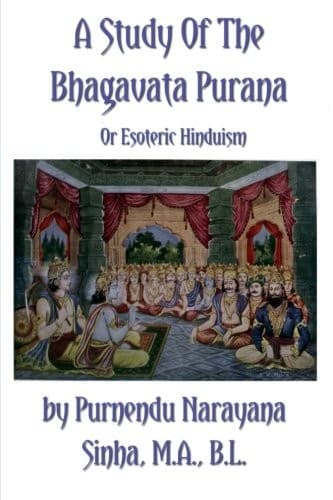
A Study of the Bhâgavata Purâna; or, Esoteric Hinduism
Religion
A Study of the Bhâgavata Purâna; or, Esoteric Hinduism
Puranas. Bhagavatapurana. English
"So let it be, Om!" said Bhagavati, and she carried out the behests of
the Lord. By inducing the sleep of Yoga, she removed the child from the
womb of Devaki to that of Rohini. People thought Devaki had miscarried.
Then Bhagavân, the Âtmâ of the Universe, the dispeller of all the fears
of his votaries, entered the Manas of Vâsudeva in part. Devaki bore in
her Manas this part of Achyuta, even as the East bears the moon. Her
lustre being confined to the prison-room could not please others, even
like fire confined as heat or like Sarasvati confined in the cheat who
keeps his wisdom to himself. Kansa saw an unusual glow round his sister
such as he had never witnessed before. He exclaimed "Surely Hari is born
in this womb, He who is to take away my life. What shall I do this day?
He comes on a mission and His energy will be all directed towards that
end. Am I then to kill my sister? But the killing of a pregnant female,
my own sister, will ruin my fame, my wealth and my life. By the
performance of such a heinous act, one becomes dead even when alive. Men
curse him for his evil deeds and after death he enters the regions of
absolute darkness."
Kansa by his own persuasion restrained himself from doing any violent
act and he waited with feelings of bitterness for the time when Hari was
to be born. But whether sitting or lying down, eating or walking, he
thought of Vishnu and saw Him everywhere in the Universe.
Brahmâ, Śiva, the Rishis, the Devas adored Vishnu in the womb of Devaki.
"True in thy will, attainable by Truth, the one Truth before, after and
in creation, the root of the Universe, and underlying the Universe as
its only Reality, Thou from whom all true sayings and true perceptions
do proceed, Truth Thyself, we take Thy shelter."
"The primal Jiva tree stands on the field of Prakriti. Joy and sorrow
are its fruits. The three gunas (Satva, Rajas and Tamas) are its three
roots. Dharma (the means of attaining objects), Artha (the objects),
Kâma (desires) and Moksha (freedom from desires), these are its fourfold
juice, the five senses are its sources of perception, the six sheaths
form its chief feature, the seven constituents of the physical body
(_dhâtus_) form its skin, the five Bhûtas, Manas, Buddhi and Ahankâra
are its eight branches, the nine openings are its holes, the ten Prânas,
or physiological functions, are its leaves and Jivâtma and Paramâtmâ are
the two birds sitting on this tree. Thou art the one root of this tree,
it ends in Thee and it is preserved by Thee. Those that are deluded by
Thy Mâyâ see manifold forms in place of Thy real self, but not so the
wise. Thou art consciousness itself. For the good of the world, Thou
dost assume Satva-made forms, which bring joy to all good people and woe
to the evil-minded."
Public-domain text, read in full here on John Shaqi.
Reviews
Reviews
No reviews yet
Be the first to share your thoughts on this work.
Elsewhere in the archive
Join the Discussion
Join the discussion
Sign in to leave a comment or review.
Sign InorCreate an account