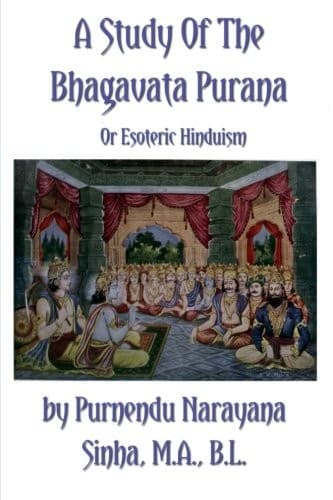
A Study of the Bhâgavata Purâna; or, Esoteric Hinduism
Religion
A Study of the Bhâgavata Purâna; or, Esoteric Hinduism
Puranas. Bhagavatapurana. English
"If it be so, O King of Bhoja, we will kill all children, whether ten
days old or not, whether found in towns, villages, or pasture grounds.
What can the Devas do, cowards in battle? They are always afraid of the
sound of thy bow. Dost thou not remember how, pierced by thy arrows,
they fled for their lives. The Devas are only bold when they are safe,
and they indulge in tall talk outside the battle ground. Vishnu seeks
solitude. Śiva dwells in forests. Indra has but little might. Brahmâ is
an ascetic. But still the Devas are enemies. They are not to be
slighted. Therefore engage us, your followers, in digging out the very
root of the Devas, for like disease and sensuality when neglected at
first, they become difficult of suppression. Vishnu is the root of the
Devas, and he represents the eternal religion (Sanatana Dharma _i.e._
Dharma that follows the eternal course of time, or is based on the
eternal truths of nature, hence eternal religion, a term applied to
Hinduism proper). And the roots of Dharma are the Vedas, the Cows, the
Brâhmanas, Tapas and Yajna. Therefore by all means, O King, we shall
kill the Deva-knowing, Yajna-performing and ascetic Brâhmanas and cows
that supply the sacrificial ghee. Brâhmanas, Cows, Vedas, asceticism,
truth, restraint of the senses, restraint of the mind, faith, kindness,
forbearance and sacrifices these are the parts of Vishnu’s body.
Therefore the best way to kill him is to kill these. Vishnu, who
pervades all hearts, is the guide of all Devas, the enemy of Asuras. He
is the root of all Devas, including Śiva and Brahmâ."
Kansa approved of this counsel. He directed the Kâmarupa bearing (_i.e._
bearing forms at will) Asuras to oppress all good people and they
readily took to their work.
NANDA AND VASUDEVA.
*SKANDHA X. CHAP. 5.*
Nanda performed the birth ceremony of his son with great pomp. His gifts
knew no bounds. Vishnu was worshipped and there was plenty in Vraja. The
time came for payment of the year’s dues to Kansa. So Nanda left Gokula
( _i.e._ Vraja ) in charge of the Gopas and himself went with the dues
to Mathurâ. Vâsudeva learned of Nanda’s arrival and went to meet him.
Nanda stood up to receive him and embraced him heartily. Said Vâsudeva:
—
"Brother, you grew old and gave up all hopes of having a child. Luckily
a son is now born unto you. It is indeed a new birth to you, that you
are blessed with the sight of a lovely son. Friends cannot live
pleasantly together as their manifold Karma, like a strong wind, forces
them asunder. Is it all right with the big forest, with the pasture
lands where you now dwell with friends? Is it all right with my son
(Balarâma) who lives at your place with her mother, and who looks upon
you as his parent?"
Nanda replied: —
"Alas! your sons by Devaki were all killed by Kansa; even the daughter
that was born last has ascended to the heavens. Surely man is governed
by the unseen. Those that know are not deluded." Said Vâsudeva: —
Public-domain text, read in full here on John Shaqi.
Reviews
Reviews
No reviews yet
Be the first to share your thoughts on this work.
Elsewhere in the archive
Join the Discussion
Join the discussion
Sign in to leave a comment or review.
Sign InorCreate an account