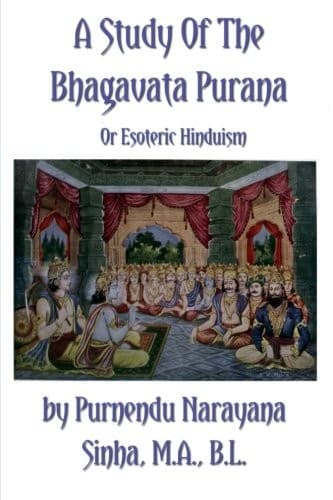
A Study of the Bhâgavata Purâna; or, Esoteric Hinduism
Religion
A Study of the Bhâgavata Purâna; or, Esoteric Hinduism
Puranas. Bhagavatapurana. English
"The Gopis all returned to the forest and searched for Krishna as long
as there was moonlight. They gave up their search when it was dark. With
thoughts all directed to Krishna, with conversations all about Him, with
gestures and movements all after Him, with songs all about His deeds,
the Gopis, all full of Krishna, they did not think of their homes. They
went to the banks of the Yamunâ, and all sang in a chorus about Krishna,
ardently praying for his return. (I shall not touch with my profane hand
the songs of the Gopis. They are far too sacred for any rendering into
English and they baffle any attempt to do so. Sweet as nectar, the
melody of those songs is inseparable from their very essence, and he
would be murdering Bhâgavata who would attempt to translate those songs.
For the continuity of our study it is only necessary to translate the
fourth sloka.)
"’Thou art not surely the son of Yasodâ. Thou art the inmost seer of all
things. Implored by Brahmâ thou hast appeared, O friend, in the line of
the Sâtvats, for the protection of the Universe.’ While the Gopis were
thus bewailing in melodious tunes, Krishna appeared with a smiling face.
They formed a circle round Him and were so pleased to see Him that they
reached the very limit of their joy. The Gopis spread out their outer
garments as a seat for Sri Krishna, on the river bank. When Krishna sat
down, they addressed him thus: —
"’Some seek those only that seek them; some do the contrary, (_i.e._
seek those even who do not seek them), others seek neither those that
seek them nor those that do not seek them. Please tell us, what is all
this.’
"Said Śri Krishna: — ’Those that seek each other are guided in their
efforts by selfishness. There is neither friendship nor virtue in that
mutuality. It is all for a selfish end. (Even the beasts seek mutual
good. _Śridhara_. And do not the Utilitarians and the evolutionists do
so)? Those that seek the unseeking are either kind-hearted men or they
are guided by affection like the parents. It is pure virtue in the
former case and friendship in the latter.
"’Those that do not seek the people that seek them and far less those
that do not seek them fall under one of the following four classes: —
Public-domain text, read in full here on John Shaqi.
Reviews
Reviews
No reviews yet
Be the first to share your thoughts on this work.
Elsewhere in the archive
Join the Discussion
Join the discussion
Sign in to leave a comment or review.
Sign InorCreate an account