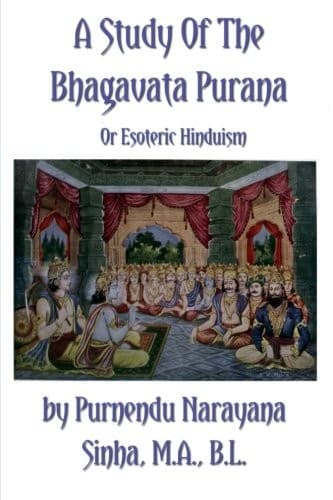
A Study of the Bhâgavata Purâna; or, Esoteric Hinduism
Religion
A Study of the Bhâgavata Purâna; or, Esoteric Hinduism
Puranas. Bhagavatapurana. English
Suka said: — Even the great are seen to violate what we call Dharma and
the gods become over bold. But this does not bespeak any evil of them,
as they have got superior force, even as fire eats everything but is
ever pure. But he who is not capable (_i.e._ who is a slave to his body
and its attributes) is not to perform such acts even in mind. If he does
such acts through ignorance, he is sure to be ruined. It is only Śiva
that could drink the poison that appeared from the ocean of milk. The
words of the Lords (Ísvara) are true. Their deeds are only sometimes
true, (_i.e._ their exceptional life, which is governed by extraordinary
consideration and unusual conditions, is not meant always as an example
for ordinary beings. But what they say is always for the good of the
universe and is to be followed as a teaching. What is given as their
life is also sometimes allegorical and has to be understood in another
sense). The wise man therefore follows such of their deeds as are
consistent with the other words of the great ones. They have nothing to
gain or lose by good or bad deeds. For they have no Egoism in them. What
is good and what is bad to him who is the Lord of all beings? By
devotion to His feet and by power of Yoga, even Munis are freed from the
bonds of good and evil. The Lord did only assume a body at will. Whence
could there be any bondage in His case? (And was there really an
enjoyment of others’ wives? No for He dwells in all beings, even the
Gopis and their husbands. He is the manifestor of all the senses. The
assumption of the body is only a playful fancy. It is for the good of
all beings that He became a man. His indulgences are such as are likely
to make one devoted to Him, when heard of. Even the minds of those that
are very much turned away from Íśvara are attracted towards Ísvara, by
means of Sringâra Râsa or love topics. Hence the love matter of Sri
Krishna. This is the purport. _Śridhara_) The people of Vraja, deluded
by the Mâyâ of Krishna, thought that their wives were by their side.
They bore no ill-feeling towards Krishna. (It follows that those who
perform such acts without such powers are sinners. _Śridhara_.)
When it was Brahmâ Muhurta, (the part of the night immediately preceding
the dawn), the Gopis, with the permission of Śri Krishna, reluctantly
left Him and went home.
He who hears or recites this play of Vishnu with the women of Vraja
acquires supreme devotion to Bhagavat and shakes off in no time that
disease of the heart called Kâma or passion for women.
SUDARSANA.
*SKANDHA X. CHAP. 34.*
(The Râsa is a teaching about conquering Kâma by treating of indulgence
in Kâma itself. Similarly this chapter treats of the conquest of
Vidyadhara. _Śridhara_.)
Public-domain text, read in full here on John Shaqi.
Reviews
Reviews
No reviews yet
Be the first to share your thoughts on this work.
Elsewhere in the archive
Join the Discussion
Join the discussion
Sign in to leave a comment or review.
Sign InorCreate an account