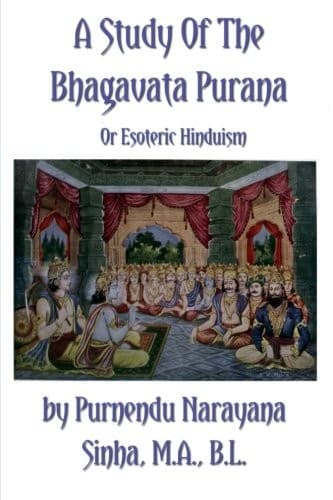
A Study of the Bhâgavata Purâna; or, Esoteric Hinduism
Religion
A Study of the Bhâgavata Purâna; or, Esoteric Hinduism
Puranas. Bhagavatapurana. English
so noble, so glorious, as the centre afforded by Lord Krishna. When
Krishna incarnates, He cannot do so singly. The Gopis appear with Him.
The Chaitanya Charitâmrita, which embodies the teachings of Chaitanya,
says that the Lilâ of Krishna is reproduced throughout the fourteen
Manvantaras over all parts of the Brahmânda, just as days and nights are
produced over all parts of the earth. The Lilâ is constantly performed
in Goloka, and it is reproduced over parts of Brahmânda, according to
the will of Krishna. Vrindâvana is only a reflection of Goloka.
When we go to Mathurâ, we find the Asura attendants of Kansa
representing all the predominating vices of the time. Pride, arrogance,
envy and malice, worldliness and anger, all that keep up the materiality
in man were to be found among the best of his followers and advisers.
They were all subdued and Kansa himself brought down from his high
platform.
When Krishna went to Mathurâ and Dvârakâ, we find him as an Avatâra,
inaugurating a new era in the spiritual history of the Universe. We find
him there in all His majesty, glory and divine lordship. Those who
follow him there follow the path of Divine Lordship. Those who follow
Him at Vrindâvana follow the path of Divine Love and sweetness.
*END OF VRINDAVANA LILÂ,*
MATHURÂ LILÂ
THE HUNCH-BACKED GIRL AND THE PÂNDAVAS.
*SKANDHA X. CHAP. 48-49.*
To keep his word, Sri Krishna went with Uddhava to the house of the
hunch-backed girl. He gratified her desire and gave her what she wanted.
Sri Krishna then went with Râma and Uddhava to the house of Akrûra.
Akrûra rose up to receive them. He adored Krishna saying: — "Thou hast
come down for the good of the Universe. Whenever the olden path of the
Vedas is crossed by the evil paths of unbelievers, Thou dost manifest
Thyself, as now, by the attribute of Satva."
Sri Krishna said: —
"Good people like yourselves are to be always adored by men and the
Devas. For while Devas are self-seeking, Sâdhus are not so. The places
of sanctity on the earth and idols and stones, that symbolise divinity,
have the power to purify the mind after long service, while the very
sight of Sâdhus is purifying. Go thou to Hastinâpura and make enquiries
about the Pândavas. They are still young and they have lost their
father. We hear they are living with Dhritarâshra. But the blind king is
too much in the hands of his evil sons and he may not be impartial to
his nephews. So enquire whether his treatment of them is good or bad.
When I know that, I shall do what is best for my friends."
Akrûra went to Hastinâpura and learned from Vidura and Kunti the cruel
treatment of the Pândavas by Dhritarâshra and his sons. Dhritarâshra
confessed that he could not hold the balance evenly between his sons and
nephews, as his attachment for his sons was too great.
Akrûra returned to Mathurâ and informed Râma and Krishna of all that he
had heard.
JARA SANDHA, YAVANA AND DVARAKA.
*SKANDHA X. CHAP. 50.*
Public-domain text, read in full here on John Shaqi.
Reviews
Reviews
No reviews yet
Be the first to share your thoughts on this work.
Elsewhere in the archive
Join the Discussion
Join the discussion
Sign in to leave a comment or review.
Sign InorCreate an account