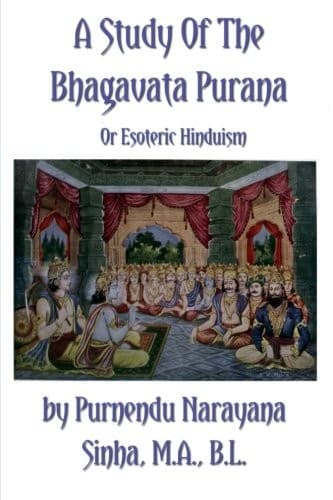
A Study of the Bhâgavata Purâna; or, Esoteric Hinduism
Religion
A Study of the Bhâgavata Purâna; or, Esoteric Hinduism
Puranas. Bhagavatapurana. English
"Arjuna heard that Râma was going to give Subhadrâ (the cousin of
Arjuna) in marriage to Duryodhana. He disguised himself as a Sanyâsîn
and went to Dvârakâ. The people of Dvârakâ and even Râma could not
recognise him. Arjuna lived there for a year and received due
hospitality. Once Arjuna was invited by Balarâma and he was taking his
food when Subhadrâ passed by him. They looked at each other and felt
mutual love. One day, Subhadrâ, with the permission of her parents and
of Sri Krishna, came out on a chariot to worship an idol outside the
fort and a strong guard accompanied her. Arjuna availed himself of this
opportunity and carried away the girl by force. Balarâma became greatly
enraged. But Sri Krishna and other friends appeased him."
SRUTADEVA AND BAHULÂSVA.
*SKANDHA X. CHAP. 86.*
Srutadeva, a Brâhmana of Mithila, was much devoted to Sri Krishna. The
prince of Mithila, Bahulâsva, was also a favorite of Sri Krishna. To
favor them, Sri Krishna went with Nârada and other Rishis to Mithila.
Srutadeva and Bahulâsva each asked him to go to his own house. Krishna
to please them both went to the houses of both at the same time, being
unnoticed by each in respect of his going to the other’s house. Both
Bahulâsva and Srutadeva received Sri Krishna and the Rishis with due
respect. Sri Krishna taught Srutadeva to respect the Brâhmana Rishis as
much as he respected him. After giving proper instructions to the prince
and the Brâhmana for sometime, Sri Krishna returned to Dvârakâ.
THE PRAYER TO BRAHMAN BY THE SRUTIS.
*SKANDHA X. CHAP. 87.*
Râjâ Parikshit asked: —
"O Great Sage, Brahmân is undefinable, void of Gunas, beyond both causes
and effects. How can the Srutis, which have the Gunas for their Vritti
(_i.e._ which treat of Devas and sacrifices which are full of
attributes), directly cognise Brahmân?"
Suka replied: —
"The Lord created Buddhi, Indriya, Manas and Prana in Jivas that they
might obtain their objects (Mâtrâ), their birth-producing Karma (Bhava),
their transmigration to different Lokas (Âtmâ), and also their Mukti
(Akalpana)." (These four words respectively mean Artha, Dharma, Kâma and
Moksha. The Srutis treat of Bhagavat, of Sat-Chit-Ananda the
all-knowing, the all-powerful, the lord of all, the guide of all, the
all-object of Upâsanâ, the Dispenser of all fruits of Karma, the Resort
of all that is good, as one with attributes. The Srutis begin with
attributes, but at last drop these attributes saying "Not this", "Not
this" and end in Brahmân. The sayings about Upasan and Karma treat of
things with attributes, as a means to attain wisdom and thereby
indirectly lead to Brahmân. This is the purport. _Śridhara_.)
"The Upanishad speaks of Brahmân. She was accepted as such by even those
that were older than those whom we call old. He who accepts her with
faith attains well-being." (The Bhâgavata tries to refute the idea that
the Vedas treat of the Devas only and not of Ísvara and Brahmâ).
Public-domain text, read in full here on John Shaqi.
Reviews
Reviews
No reviews yet
Be the first to share your thoughts on this work.
Elsewhere in the archive
Join the Discussion
Join the discussion
Sign in to leave a comment or review.
Sign InorCreate an account