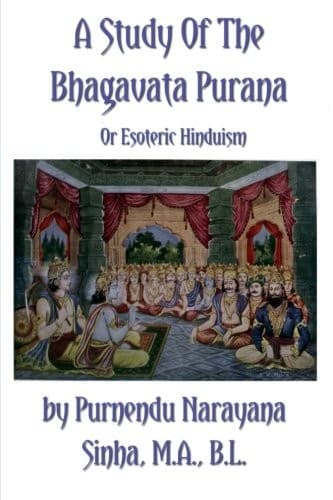
A Study of the Bhâgavata Purâna; or, Esoteric Hinduism
Religion
A Study of the Bhâgavata Purâna; or, Esoteric Hinduism
Puranas. Bhagavatapurana. English
From that Kâlpic plane and the dweller thereof, we come to lower planes
and their dwellers, to the divisions of time that rule the lives of
individuals and of lives adapted to these divisions of time. We come
from the elementals of the Svarga plane, or the Devas, to the elementals
of the Astral or Bhuvar plane, the Pitris, Bhûtas, Pretas and Pisâchas,
till we reach the mineral kingdom, represented by Himalya, the Mountain
king. At this point a turning point was reached in life evolution, and
the goddess of life-evolution became the daughter of the Mountain king.
Of this we shall know more hereafter.
We know of Daksha, first as the son of Brahmâ, the creative Prajâpati
when the life-process rapidly worked itself out in Elemental forms. Then
there was no sexual procreation. Creation meant the materialisation of
the Jiva. Satî, the daughter of Daksha, was the guiding energy of
life-evolution. She became wedded to Śiva, the Lord of Bhûtas, Pretas
and Pisâchas who by the infusion of their Tâmasic energies could bring
down Jivas from their high spiritual plane.
When the process of materialisation was over, when the Jivas or Monads
reached the lowest limits of materiality, the mission of Daksha came to
an end.
Life evolution had now to pass through mineral, vegetable and animal
stages, until at last the human stage was reached.
Satî now appeared as the daughter of the mineral king Himâlaya. She gave
the upward bent to life evolution and by the energy she imparted
minerals were able to shake off the rigidity and stability of gross
matter, to develop the sense of touch and to become vegetable at last.
In like manner vegetable became animal, and animals at last became men.
Śiva, the husband of Bhagavati or Durgâ, as Satî was now called, is the
Purusha of Dissolution. Bhagavati is His Energy, Who guides the Monadic
or Jiva Evolution of the Kalpa. It is the wear and tear, the process of
destruction, that counteracts the cohesive strength of the particles
forming mineral matter, which by its action becomes flexible and so
receptive of outside influences.
Cells by division and death become capable of the life process in
themselves. Vegetables grow by the rejection of cells, which
necessitates a number of physiological processes. Death brings on life,
waste, repair.
If animals exist in one and the same body, progress will be limited,
further evolution will be impossible. It is by death that we evolve.
Bhagavatî works out the evolution of life in different kingdoms till the
stage of humanity is reached.
At this point Aryaman, one of the Âdityas, comes to the help of
humanity. Through his influence the sons of humanity become endowed with
the power of reasoning, — the faculty of discrimination.
Public-domain text, read in full here on John Shaqi.
Reviews
Reviews
No reviews yet
Be the first to share your thoughts on this work.
Elsewhere in the archive
Join the Discussion
Join the discussion
Sign in to leave a comment or review.
Sign InorCreate an account