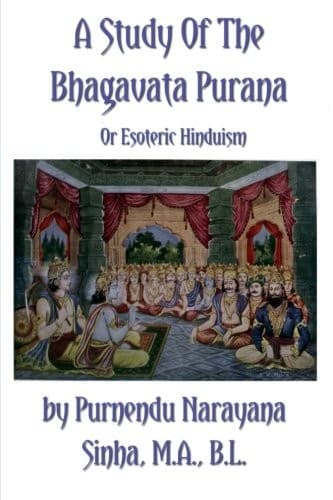
A Study of the Bhâgavata Purâna; or, Esoteric Hinduism
Religion
A Study of the Bhâgavata Purâna; or, Esoteric Hinduism
Puranas. Bhagavatapurana. English
The sons of Aryaman are called Charshanis. The word Charshani literally
means a cultivator. Its secondary sense given in the Vedic lexicon is
one endowed with the discriminative faculty. The word Charshani is used
in the Vedas for man. It is the equivalent of Arya or Aryan, the
ploughman. But it is not as ploughmen or cultivators, that the Aryans
had their high place in humanity, but as men endowed with the power of
discrimination. And this we owe to Aryaman. This is why, though an
Âditya, he is called the chief of Pitris by Sri Krishna.
"I am Aryaman of the Pitris." — Bhagavat Gitâ.
We have thus the first stage in life evolution, when the spiritual Jiva
had to descend from the elemental to the mineral form. Next we have the
second stage, when minerals passed through higher forms of life till the
Human Kingdom was reached.
Then we have the third stage, when men became endowed with the power of
discrimination.
In the exercise of the discriminative faculty men were helped by their
elder brothers, the Rishis and Mahâtmâs of every period, and by Avatâras
Who apeared from time to time.
Then the ground was prepared for further evolution. The Sacred
Injunctions or the Vedas were revealed to men to give them a sense of
right and wrong, of duties and prohibitions. The Vedas also held out to
the developed sense of men the charming prospect of life in Svarga Loka
with its lasting and alluring enjoyments. This may be called the stage
of Karma Kânda. In following the stages of human evolution we have come
down to Vaivasvatu Manvantara.
Side by side with the efforts made to raise humanity in the scale of
evolution, sin was accumulating in the great Atlantean continent which
spread over the whole of what we now know as the Bay of Bengal. The
Atlanteans had acquired a mastery over the five forces of nature, which
they used for selfish objects and against the cause and current of
evolution.
Then there was a great revolution in Nature. The great Atlantean
Continent went down with its load of sins. The sons of Sagar, the
Atlantean king, became buried under the great ocean, which overtook the
doomed continent, and to this day the sea is called in India, "Sâgar" or
relating to Sagar.
There was a corresponding upheaval in the Himalayas, and the sacred
river Gangâ streamed forth from their sides, inaugurating the spiritual
regeneration of the Universe. Much of what we now know as India must
have been raised up at the time, and on its sacred soil appeared the
great Avatâra Râma, Who put an end to the disorganising, chaos-loving
sons of Lankâ. The people of Lankâ were called Râkshasas as they were
working towards the destruction of all order, all progress in the
Universe, and rendered everything topsy-turvy in Nature.
Public-domain text, read in full here on John Shaqi.
Reviews
Reviews
No reviews yet
Be the first to share your thoughts on this work.
Elsewhere in the archive
Join the Discussion
Join the discussion
Sign in to leave a comment or review.
Sign InorCreate an account