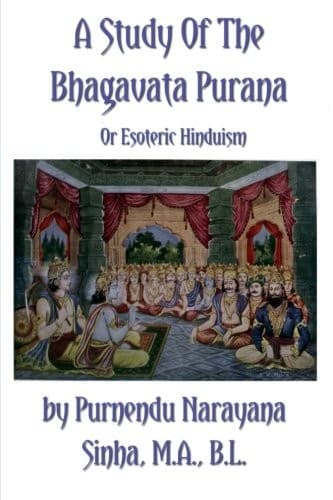
A Study of the Bhâgavata Purâna; or, Esoteric Hinduism
Religion
A Study of the Bhâgavata Purâna; or, Esoteric Hinduism
Puranas. Bhagavatapurana. English
According to a Pauranik legend, the Vindhya mountain began to rise
higher and higher so as to obstruct the path of the sun and moon. The
gods being alarmed sought the aid of Agastya who was the teacher of
Vindhya. The Rishi approached the mountain and asked it to bend down and
give him an easy passage to the south and to retain the same position
till his return. Vindhya obeyed the order of his teacher, but Agastya
never returned from the south and Vindhya never attained the height of
Meru.
According to the Bhâgavata, Agastya is the digestive fire of the
stomach.
Visravas = Vi (signifying intensity) + Sravas (ear).
Kubera is literally deformed. He is the god of riches and Regent of the
North. He is the king of the Yakshas and Kinnaras and a friend of Rudra.
His abode is Kailâsa. He is represented as having three legs, only eight
teeth and a yellow mark in place of one eye.
Râvana, Kumbhakarna and Vibhishana are Râkshasas made famous by the
Râmayana.
Râvana is one who makes a loud noise. The Râkshasas reached the height
of their power in his time. The Yakshas, before his time, had occupied
Lankâ or Atlantis under Kubera, but Râvana propitiated Śiva by his loud
hymns, and acquired easy mastery over his kindred elementals. He ousted
the Yakshas from Lankâ and made it his own capital. Râvana also
controlled the higher Devas of Trilokî.
Kumbha karna = Kumbha (pitcher) + Karna (ear). This pitcher-eared
brother of Râvana is said to have devoured thousands of beings including
sages and heavenly nymphs. He slept for six months at a time. He was
ultimately slain by Râma.
Vibhisana, meaning the Terrible, left his brother Râvana and joined
Râma. After the death of Râvana, Râma installed him on the throne of
Lankâ. He is said to be still living.
The Râkshasas are said to have possessed Kâma Rupa _i.e._ they could
assume any body at will.
In the line of Pulastya we have this strange combination — the digestive
fire of stomach, ears, Yakshas and lastly the Râkshasas who could change
their body at will. Altogether we may say, Pulastya is Intelligence
which governs animal passions and Kâma.
TABLE G.
Pulaha = Pula + ha. _Ha_ is one who gives up.
_Gati_ is motion.
_Karma-Srestha_ is one most skilled in karma or work.
_Varîyas_ is excellent, preferable.
_Sahishnu_ is patient, enduring.
Pulaha seems to be the higher aspect of Kâma — the impulses pure and
simple, apart from their Kâmic generator, or perhaps Pulaha may
represent Prânic activity.
TABLE H.
Kratu is a Vedic sacrifice, intelligence, power, ability. Kriyâ is
action.
Bâlakhilyas — are a class of Rishis 60,000 in number, of the size of the
thumb, and are said to precede the sun’s chariot. The word literally
implies stunted in growth like infants. These Rishis are said to burn
brightly with the spiritual fire of asceticism. The number 60,000 is
significant. It indicates a correspondence.
Public-domain text, read in full here on John Shaqi.
Reviews
Reviews
No reviews yet
Be the first to share your thoughts on this work.
Elsewhere in the archive
Join the Discussion
Join the discussion
Sign in to leave a comment or review.
Sign InorCreate an account