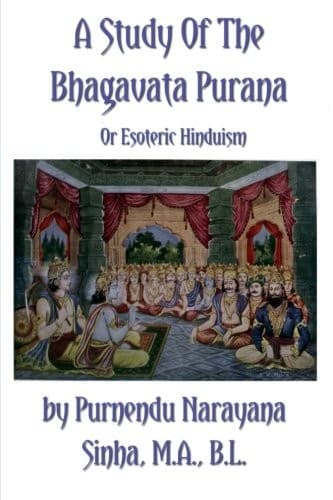
A Study of the Bhâgavata Purâna; or, Esoteric Hinduism
Religion
A Study of the Bhâgavata Purâna; or, Esoteric Hinduism
Puranas. Bhagavatapurana. English
_Prasûti_ — is the Mother, the Procreative Energy. During the First
Manvantara Daksha had nothing to do with sexual procreation. He was the
father of 16 primal energies. These energies were wedded to Dharma,
Agni, the Pitris and Śiva — 13 to Dharma and one to each of the others.
_Dharma_ — is that which binds the creation. Man and man, man and
animal, animal and animal, all forms of creation are kept together by
Dharma. The binding forces of creation are the wives of Dharma.
_Sraddhâ_ or Faith is the first wife of Dharma. Her son is _Satya_ or
Truth.
_Maitri_ or Friendliness is the second wife. Her son is _Prasâda_ or
complacence.
_Dayâ_ or compassion is the third wife. Her son is _Abhaya_ or Freedom
from fear.
_Sânti_ or Peace is the fourth wife. Her son is _Sama_ or Tranquility.
The fifth wife is _Tushti_ or contentment. Her son is _Harsha_ or joy.
The sixth wife is _Pushti_ or Fullness. Her son is _Garva_ or Pride.
The seventh wife is _Kriyâ_. Her son is _Yoga_.
The eighth wife is _Unnati_ or Advancement. Her son is _Darpa_ or
Vanity.
The ninth wife is _Buddhi_. Her son is _Artha_.
The tenth wife is _Medhâ_ or Intellect. Her son is _Smriti_ or Memory.
The eleventh wife is _Titikshâ_ or Forbearance. Her son is _Kshema_ or
Well-being.
The twelfth wife is _Lajjâ_ or Shame. Her son is _Vinaya_ or Modesty.
The thirteenth and last wife of Dharma is _Mûrti_ or Form. Her sons are
Nara and Nârâyana, _i.e._ Humanity and Divinity. The Human Form
constitute a Duality. It is in this dual form that Sri Krishna
incarnated Himself.
From Dharma we pass to Agni.
[Agni is used in many senses. It means the channel of communication
between different kingdoms in nature, specially between Man and Deva, as
also a vehicle of consciousness, and sometimes consciousness itself. It
also means the Rupa or form-giving principle in the Universe. It is
frequently used in the Purânas in the last sense.]
Agni was wedded to _Svâhâ_, the 14th. daughter of Daksha. His three sons
are _Pâvaka_ or the Purifier, _Pavamân_ or that which is being purified
and _Sâchi_ or Pure. They have 45 sons who with their fathers and
grandfather form the Forty-nine Fires. They are separately mentioned in
the Vedic Sacrifices in honour of Agni.
_Svadhâ_ is the 15th. daughter of Daksha. She was married to the Pitris.
Agnishvatvâ, Barhishad, Sōmapa and Âjyapa are the names of the Pitris.
They are with fire (Sagni) or without fire (Niragini). Svadhâ bore two
daughters to the Pitris, Vayunâ and Dhârini. Both of them were
well-versed in the Supreme wisdom.
[_Vayânâ_ is knowledge, wisdom, faculty of perception. _Dhârini_ means
that which bears, holds, carries, supports. Sometimes the word is used
to mean the earth.
This two-fold classification means that some of the Pitris give the
_body_, which is the receptacle or carrier, with its sub-divisions, and
others give knowledge, wisdom and the faculties of perception].
Public-domain text, read in full here on John Shaqi.
Reviews
Reviews
No reviews yet
Be the first to share your thoughts on this work.
Elsewhere in the archive
Join the Discussion
Join the discussion
Sign in to leave a comment or review.
Sign InorCreate an account