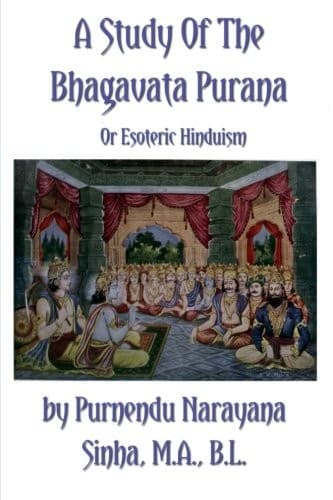
A Study of the Bhâgavata Purâna; or, Esoteric Hinduism
Religion
A Study of the Bhâgavata Purâna; or, Esoteric Hinduism
Puranas. Bhagavatapurana. English
Bhrigu, the leader of the Brâhmanas, thus returned the curses of Nandi
on the followers of Śiva: — "Those that will follow Śiva, shall be
disregardful of the Sat (real) Śastras and shall be irreligious. With
braids of hair on their head, and ashes and bones round their body, they
shall frequent places where wine is indulged in. The Vedas have at all
times laid down the approved path. The Rishis of old followed their
injunctions and Nârâyana is at their very root. Those that forget all
this shall only attain the Tâmasic Śiva, the Lord of Bhûtas and
Pishachas."
Śiva with his followers then left the place. The Prajâpatis performed
the Yajna for 1,000 years.
Sometime after, Brahmâ made Daksha the head of the Prajâpatis, and his
pride knew no bounds. He commenced a sacrifice called Vrihaspati Yajna
and to it he invited all except Śiva and his own daughter Sâti. Sâti
heard of the grand preparations made by her father and became impatient
to witness the Yajna herself. Śiva at last yielded to her expostulations
much against His own will. She left for Daksha’s house accompanied by
the attendants of Śiva. At last she reached her father’s house and went
to the place of sacrifice. But her father would not receive her. She did
not find any offering to Śiva. She could easily make out that Daksha had
disregarded her husband. No attention was also paid to her. She grew
furious with rage and addressing her father said: — "With Śiva, all are
equal. He has enmity with none. Who else but thee could be envious of
his virtues? Thou hast attributed evil things to Śiva. But do not the
Devas know all that and knowingly worship Him? If the devoted wife
cannot kill her husband’s calumniators, she must leave the place with
ears closed with her hands. But if she is strong enough, she must in the
first place sever the tongue of the calumniator from his body by force
and then put an end to herself. Thou art the calumniator of Śiva. This
my body is from thee, so I shall not keep it any longer. If prohibited
food is taken, the best thing is to throw it out. True, there are the
two Paths of Inclination (Pravritti) and of Renunciation (Nivritti). But
one cannot adopt both the Paths at one and the same time. What action is
there for Śiva? He is Brahmâ Himself. Thou speakest of His ashes and
bones. But hast thou any idea of His Yogic powers, in comparison with
which thy powers as a performer of Vedic sacrifices are nothing? But
there is no use wrangling with thee. I am ashamed of this body which has
connection with thee. The sooner I get rid of it the better."
So saying Sâti gave up her body, and there was great uproar. Her
attendants made ready for an attack, when Bhirgu, who acted as Adhvaryu,
invoked the Ribhus. They appeared and beat the attendants of Śiva, who
ran away on all sides.
Nârada informed Śiva of what had happened. Śiva bit His lips in anger
and tore up a Jatâ (matted hairtuft) from his head. The Jatâ glowed with
electric fire.
Public-domain text, read in full here on John Shaqi.
Reviews
Reviews
No reviews yet
Be the first to share your thoughts on this work.
Elsewhere in the archive
Join the Discussion
Join the discussion
Sign in to leave a comment or review.
Sign InorCreate an account