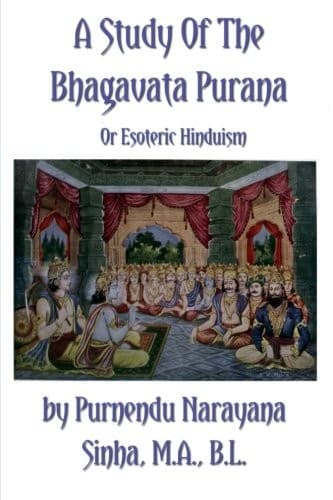
A Study of the Bhâgavata Purâna; or, Esoteric Hinduism
Religion
A Study of the Bhâgavata Purâna; or, Esoteric Hinduism
Puranas. Bhagavatapurana. English
[The line of Uttânapâda, as I have said above, represents the appearance
of individual life-forms. Limitation had to be put to the life-periods
of individuals. We commence with Dhruva, who presides over the polar
star, and lives for one Kalpa. His sons are Kalpa and Vatsara. "Vatsara"
means year. The sons of Vatsara are the six seasons. "Pushpârna" is the
flower season or spring. "Tigmaketu" means fierce-rayed. The word
denotes summer season. "Isha" means full of sat and is the name of the
month of Asvina. But it means here the rainy season. "Urja" is the name
of the month of Kartika. It is indicative of autumn. "Vasu" meaning
wealth is the season between autumn and winter, when paddy becomes ripe.
"Prabhâ" is light. "Doshâ" is darkness. "Pratar," "Madhyandina" and
Sayam are morning, midday and evening, respectively. "Pradosha" is first
part of the night, "Nisitha" is midnight. "Vyushta" is day break.
"Sarva-tejas" is all-fire. He was subsequently called Chakshus or eye.
The names other than Chakshus indicate different capacities of
individual life, ranging from portions of a day to the whole Kalpa. When
the downward flow of Jivas was the rule, Dhruva had to make great
sacrifice to remain fixed on the spiritual plane. Hence he worshipped
Vishnu, as directed by Nârada. Sarva-tejas or Chakshus perhaps indicates
the appearance of perceptive faculties. The son of Chakshus is glorified
with the title of Manu. This is significant. He is called Nadvala, or
one made of reeds. This marks a new era in the progress of Monads. As
the reed is made up of sheaths over-lapping each other, so the sons of
this Manu were constituted of overlapping principles. Why Nadvala is
called Manu, has to be found out in the circumstances that attended the
progress of the Monads from the mineral to the vegetable stage. The son
of this Manu was Anga or the limbs. And Anga was wedded to the daughter
of the death god. So there was no death up to the Nadvala form of life,
and no limbs. It was something like the appearance of protoplastic
matter, with all its potentialities of evolving life forms. Thus we can
understand the importance of Nadvala as a Manu. Death or decay made the
inorganic to develop organs or anga.]
II. THE STORY OF PRITHU.
*SKANDHA. IV. CHAP. 13-23.*
Public-domain text, read in full here on John Shaqi.
Reviews
Reviews
No reviews yet
Be the first to share your thoughts on this work.
Elsewhere in the archive
Join the Discussion
Join the discussion
Sign in to leave a comment or review.
Sign InorCreate an account