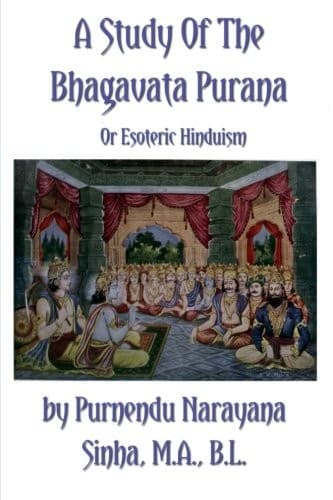
A Study of the Bhâgavata Purâna; or, Esoteric Hinduism
Religion
A Study of the Bhâgavata Purâna; or, Esoteric Hinduism
Puranas. Bhagavatapurana. English
There was a king called Puranjana. He had a friend, but the king knew
not his name nor his doings. Puranjana went in search of a place to live
in. He went about on all sides, but found no suitable abode. At last
while roaming south of the Himâlayâs, he found one Puri (town) in
Bhârata Varsha (India), The marks were all favourable. There were nine
gateways. In one of the gardens he found a most beautiful young lady.
She had ten attendants. Each of them had hundreds of wives. One
five-headed serpent was the warder of the town and he constantly guarded
his mistress. The lady was on the look out for one to be her lord.
Puranjana broke forth into words of love, and asked who she was. "O thou
greatest of men!" exclaimed the lady, "I know not who I am or who thou
art. Nor do I know who made us both. This only I know, that I now exist.
I do not know even who made this town for me. These are my companions
male and female. This serpent guards the town, even when we are all
asleep. Luckily hast thou come here. I shall try with all my companions
to bring to thee all objects of desire. Be thou the lord of this Puri
for one hundred years. And accept all enjoyments brought by me."
Puranjana entered the Puri and lived in enjoyment there for one hundred
years.
Of the nine gateways, seven were upper and two lower — five on the east
(Purva, which also means front), one on the south (Dakshinâ), one on the
north (Uttara) and two on the west (Paśchima). Two of them Khadyôta and
Âvirmukhî were close to each other and Puranjana used them whenever he
would go out to see Vibhrajita in the company of Dyumat.
Nalinî and Nâlinî were also two passages built together. Puranjana used
them with the help of Avadhûta in order to repair to Saurabha.
The Mukhyâ passage was used for Apana and Bahûdana. Through the southern
passage Pitrihû, Puranjana went with Srutadhara to Dakshinâ Panchâla and
through the northern passage Devahû, to Uttara Panchâla.
Through the western passage called Âsuri, Puranjana went with Durmada to
Grâmaka. The other western passage was called Nir-riti, Through that
passage Puranjana went with Lubdhaka to Vaiś-asa.
There were two blind gates _i.e._ without opening, viz: — Nirvak and
Pesaskrita. Puranjana used them for motion and action. He went inside
the town with Vishûchina. There he experienced Moha (delusion), Prasâda
(contentment) and Harsha (joy), caused by his wife and daughters.
Puranjana became thus attached to Karma. He slavishly followed whatever
the Queen did. If she heard, the King heard. If she smelt, the King
smelt. If she rejoiced, the King rejoiced. If she wept, the King wept.
Puranjana merged his self entirely in that of his wife.
Public-domain text, read in full here on John Shaqi.
Reviews
Reviews
No reviews yet
Be the first to share your thoughts on this work.
Elsewhere in the archive
Join the Discussion
Join the discussion
Sign in to leave a comment or review.
Sign InorCreate an account