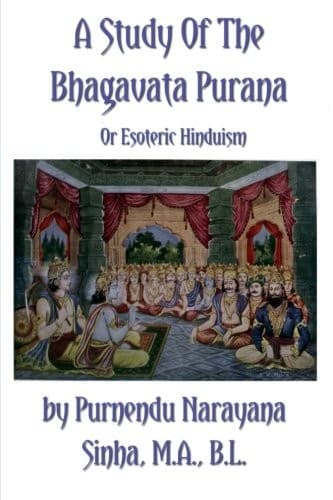
A Study of the Bhâgavata Purâna; or, Esoteric Hinduism
Religion
A Study of the Bhâgavata Purâna; or, Esoteric Hinduism
Puranas. Bhagavatapurana. English
Vijitâsva could make himself invisible. This may have reference to the
state of the body at that stage of evolution. The fires appeared as it
is they that give forms. The object corresponding to elemental fire is
Rûpa or form. Barhishad, the name of one class of Pitris, was the
progenitor of the form-producing Linga Sarira with all its
potentialities.
We find the senses developed in his sons the Prachetas brothers. "Pra"
Means perfect and "Chetas" is the perceiving mind. But the mind
perceives through the Indriyas, which are ten in number. Therefore they
are ten brothers all alike; but they are wedded to one girl Mârishâ.
There is some occult connection between water and sense perception.
Barhishad was married to the daughter of the Ocean-god. The Prachetas
brothers remained submerged for a thousand years in the waters. The
protozoa and protophytes must of necessity be aquatic, as it were, for
the development in them of sense perceptions.
It is in Touch that the sense perceptions find a common basis. Touch
underlies all other perceptions. It is touch of the object by one sense
or other that gives rise to one perception or the other. "Kandu" is
primarily scratching or itching, secondarily touch. Mârishâ was
nourished by the moon and brought up by the plants.
The period refers to the stage of evolution when the vegetables formed
the predominant creation. It corresponds somewhat to the geological
period of tree-ferns and lycopods in our Manvantara.
The development of sense perceptions is the result of a communion with
Vishnu, under the auspices of Rudra. This means a further infusion of
Satva by Vishnu, which was made possible by the Dissolving influence of
Śiva. And the son of the Prachetas brothers is verily Daksha, the
Prajâpati of procreation, reincarnated under better auspices for the
purpose of extending the creation. So we find the Trinity acting as
three in one in the creative process.
With the appearance of Daksha Jiva evolution comes to an end in the
first Manvantara.
TABLE V.
Public-domain text, read in full here on John Shaqi.
Reviews
Reviews
No reviews yet
Be the first to share your thoughts on this work.
Elsewhere in the archive
Join the Discussion
Join the discussion
Sign in to leave a comment or review.
Sign InorCreate an account